
 Water kefir
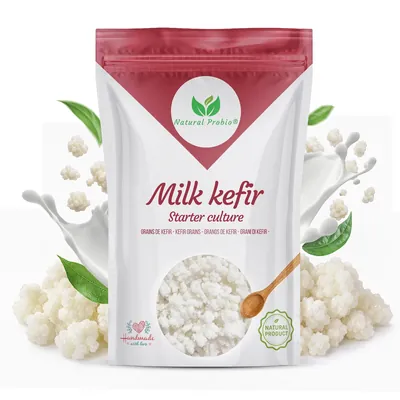 Milk kefir
 Kombucha
 Ginger beer
 Kefir duo
 Kefir and kombucha
 Starter kit
 Rennet
Put 20 g of milk kefir grains into 1 litre of whole milk, cover with a tea towel and leave it for 24 hours at 20 to 25°C. The milk thickens to the texture of a pouring yoghurt and smells fresh and slightly sour. Strain it, put the kefir in the fridge and drop the grains straight into fresh milk. With 10 g of grains you make half a litre a day. Looked after properly, the grains grow and keep going for years, and the kefir does everything buttermilk does in the kitchen.
What is milk kefir?
Milk kefir is a fermented milk you make at home with live grains. The grains look like tiny florets of cauliflower: white or cream, soft and a little jelly-like between your fingers. They hold a community of lactic acid bacteria and yeasts, wrapped in a material they build themselves. Dropped into milk, they turn the milk sugar into a gentle sourness, a lot of aroma and a hint of fizz.
The result is thicker than milk and runnier than yoghurt, with a fresh, clean tang and a faint yeasty note. Bottled kefir from the chilled aisle gives you a rough idea, but kefir made with grains tastes livelier, and it changes with the milk, the season and how long you leave it.
Your nose tells you how the jar is getting on. After a few hours it still smells of milk. By the end it smells fresh and sharp, with a hint of bread dough. Left much longer, it becomes punchy and reminds you of a young soft cheese. A smooth, pearly white means it is spot on; a little yellowish whey at the bottom means the fermentation is well advanced.
What the grains are made of, how they grow and why they only exist as a live culture is explained in What are milk kefir grains? Do not mix them up with the clear, glassy grains of water kefir, which ferment sugar water and make a completely different drink.
What you need to get started
| Ingredient or equipment | Quantity | What it is for |
|---|---|---|
| Milk kefir grains | 20 g (or 10 g) | The live culture |
| Whole milk | 1 litre (or half a litre) | What the grains turn into kefir |
| Glass jar | A little over 1 litre | Room for the milk and the grains |
| Plastic or stainless steel sieve | 1 | Separates the grains from the kefir |
| Wooden or plastic spoon | 1 | To stir the kefir through the sieve |
| Tea towel and an elastic band | 1 | Covers the jar without sealing it |
| Bottle or jar with a lid | 1 litre | To keep the finished kefir in the fridge |
The two sizes match two rhythms. With 10 g you make half a litre a day, enough for one person who takes a glass in the morning and cooks with it now and then. With 20 g you make a litre a day, for a household or for anyone who bakes. Both are on the milk kefir grains page, from £14.
The basic method, step by step
1. Grains into milk
Put the grains into the jar and pour 1 litre of whole milk over them (half a litre for 10 g). Fill to about two thirds so there is space at the top.
2. Cover and wait
Tea towel over the top, elastic band around it. Leave the jar for 24 hours at 20 to 25°C, out of the sun.
3. Strain
When the milk has set and pulls away from the glass when you tilt the jar, pour it through the sieve and stir gently with the spoon.
4. Start again
The kefir goes into the fridge, the grains straight back into a clean jar with fresh milk. No rinsing needed.
That really is the whole thing. The details (how full the jar should be, how to tell a batch is ready, what to do if you are late) are in the guide How to make milk kefir.
Kefir instead of buttermilk: the baking swap
Plenty of the best British bakes call for buttermilk: scones, drop scones, fluffy pancakes, a soft chocolate cake. They all rely on something sour to react with the bicarb and lift the mixture. Milk kefir does exactly the same job. It is sour, it is thick, and it reacts with bicarb just as buttermilk does, so you can use it in the same amount in any recipe you already have.
| Bake | Buttermilk in the recipe | With kefir |
|---|---|---|
| Scones | About 150 to 200 ml | The same, for a soft, tender crumb |
| Drop scones | About 150 ml | The same, a splash more if the batter feels stiff |
| Chocolate cake | About 250 ml | The same amount of kefir, for a moist crumb |
| Pancakes | About 250 ml | The same, or half kefir and half milk |
Scones come out with a slightly deeper flavour and a soft crumb, and you are never caught short on a Sunday afternoon because the shop had no buttermilk. Your jar of kefir is always there. The kefir from the morning batch, or even one that has gone a bit too sour to drink, is perfect for baking. Pancake Day has never been easier.
How the two compare in taste, texture and use, and how to adapt your favourite recipes, is all in Kefir or buttermilk? For something sweet, try the kefir apple cake, a proper Bramley apple cake made with kefir in place of buttermilk.
Which milk works best?
Milk kefir grains like milk with some body. Whole cow's milk (the blue top) is the easy choice, and ordinary pasteurised milk from the fridge is perfectly fine.
| Milk | Result | Good to know |
|---|---|---|
| Whole milk, pasteurised | Creamy and smooth | The best starting point |
| Semi-skimmed milk (green top) | Thinner, sharper | Works, a bit less creamy |
| Gold top (Channel Island) milk | Very rich, almost like cream | Lovely for a special batch |
| Raw milk | Full flavour, more variable | Use it only very fresh |
| UHT milk | Thinner, a slightly cooked taste | Possible now and then, not as a habit |
| Goat's milk | Thinner, with a more pronounced flavour | Works well once the grains are used to it |
| Lactose-free milk | Usually slower | Possible, try it with part of the grains |
All the milks, with their pros and cons, are in the guide Which milk for kefir? If you want to try goat's milk, read Goat's milk kefir first: the grains need a few batches to adjust. Oat, soya and other plant drinks do not keep milk kefir grains going on their own, but there is a way to use them, explained in Kefir with plant milk.
Too thin, too thick, too sour?
Texture is the thing people fiddle with most. The good news is that it is almost entirely in your hands, and three things decide it: time, temperature, and the ratio of grains to milk.
| What you get | Usually because | What to try |
|---|---|---|
| Thin, still smells of milk | Too short, too cold, too few grains | A few more hours, a warmer spot |
| Thick and lumpy | Too many grains for the milk | More milk, or take some grains out |
| Separated into curds and whey | Fermented too long or too warm | Strain earlier, shake well before drinking |
| Very sour or yeasty | A warm kitchen in summer | Strain after 18 to 20 hours |
A batch that has separated is not ruined: shake it, and use it in baking if you find it too sharp to drink. All the adjustments are in Milk kefir too thin or too thick?
Kefir at breakfast
Porridge is where milk kefir really earns its place. Pour it over a bowl of hot oats, or stir it through the night before for overnight oats: a cup of oat flakes, a cup of kefir, a grated apple or a handful of berries, into the fridge, and breakfast is waiting for you in the morning. The full method is in Kefir overnight oats.
On busy mornings, a banana kefir smoothie takes a minute: one ripe banana, a glass of kefir, a spoon of oats, into the blender. And on its own, straight from the fridge, a small glass of kefir is a good start to the day for anyone who likes a sharp, creamy taste.
Recipes beyond the glass
Milk kefir is one of the most useful things you can have in the fridge. Anywhere you would use buttermilk, natural yoghurt or sour cream, it works.
| Recipe | What it is | When |
|---|---|---|
| Strained kefir cheese | Thick, spreadable, like labneh | On wholemeal toast, with honey and fruit |
| Kefir cucumber dip | Fresh, garlicky, with dill | With crisps, crudités, grilled lamb |
| Kefir ice cream | Tangy, creamy, with fruit | Summer, or with a warm crumble |
| Kefir apple cake | Bramleys, a soft crumb, a crunchy top | Autumn, Sunday afternoons |
Strained kefir cheese is the one people fall for. Tip a litre of kefir into a sieve lined with a clean cloth, leave it in the fridge overnight, and in the morning you have a thick, tangy spread. The whey that drips out is good in bread dough, too. If you enjoy that, the next step is real cheese: see our cheese making guide.
Caring for the grains, and what to do with too much kefir
Milk kefir grains are hardy. They need fresh milk regularly, no great heat, and no rinsing in hot water. Day to day:
- Every 24 hours: strain and give them fresh milk. A few hours late does no harm.
- A weekend away: put them in fresh milk in the fridge. They slow right down.
- A longer break: more milk, a closed jar, the fridge. Then two or three normal batches to get them back on form.
- Growth: the grains get bigger. Keep about 20 g per litre and use or give away the rest.
All the details, including how to prepare the grains for a long holiday, are in Caring for milk kefir grains. How long the finished kefir keeps in the fridge is covered in How long does kefir keep?, and if the jars are piling up, Too much kefir? has plenty of ways to use them.
When something seems off
Most of the time, a batch that looks strange is simply a batch that was too warm, too cold or too long. Grains that have travelled also need a few days to settle in, and the first batches can be thin or uneven. Pink or orange patches, fluffy mould or a really unpleasant smell are a different matter: then it is time to start again with fresh milk and look closely at the grains.
The common problems, and what to do about each one, are in the guide Milk kefir problems. Most first-timers trip over the same few things, listed in Beginner kefir mistakes. And if you are unsure, write to us with a photo: we will answer you personally.
Kefir or yoghurt?
Both are fermented milks, but they are made very differently. Yoghurt needs warmth, around 40°C, and a spoon of the previous batch, which tends to weaken over time. Kefir sets at room temperature with grains that grow and keep going. Kefir is runnier, sharper, slightly fizzy and more complex in flavour; yoghurt is thicker and milder. The full comparison is in Kefir or yoghurt?
Buying milk kefir grains
UK supermarkets sell drinking kefir in bottles, but not live grains. Our live milk kefir grains arrive alive, in their own liquid, with instructions and recipes, in 10 g or 20 g. Our cultures come from traditional methods: unique and vigorous.
Pay by Visa or Mastercard debit or credit card, Apple Pay, Google Pay, PayPal or Klarna (pay in 3). Standard tracked delivery costs £4.90 and is free from £35 (3 to 6 working days across the UK), and express tracked delivery costs £14.90 (3 to 5 working days, with Royal Mail on the last leg). All prices include VAT. Orders leave within 24 to 48 working hours. The details are on Delivery and payment, and what a litre of homemade kefir costs compared with the bottled kind is in The cost of making kefir at home.
Milk kefir, water kefir, or both?
Milk kefir is creamy and belongs at breakfast and in the kitchen; water kefir is fruity, dairy-free and fizzy, a drink for any time of day. Many people end up with both jars on the worktop. The two are compared in Water kefir or milk kefir?, and the kefir duo brings you 20 g of milk kefir grains and 30 g of water kefir grains together. If you would like to try kombucha too, the complete fermentation starter kit has all three. Still deciding? Which ferment suits me? helps.