
 Water kefir
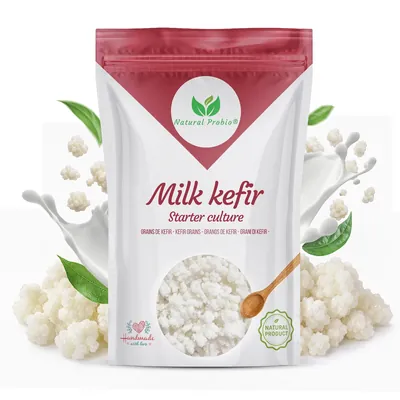 Milk kefir
 Kombucha
 Ginger beer
 Kefir duo
 Kefir and kombucha
 Starter kit
 Rennet
Milk kefir grains also work in goat's milk, but switch them over gradually: start with a quarter goat's milk and move to all goat's milk over a week. As with cow's milk, use 20 g of grains per litre, 24 hours at 20 to 25°C. Goat's milk kefir is thinner, whiter and sharper. To thicken it, leave it a little longer or drain it. Give the grains a batch of whole cow's milk now and then.
What does goat's milk kefir taste like?
The first thing you notice is the colour. Goat's milk kefir is a clean, bright white, almost snow white, because goat's milk carries less of the yellow colouring found in cow's milk. It tastes lighter and fresher, with a soft sourness and the typical goaty note: a little herby, a little grassy, sometimes with a hint of nuts. How strong that note is depends on the milk. Very fresh goat's milk is mild; milk that has been open a few days is more pronounced.
In texture it is thinner than cow's milk kefir. Goat's milk protein sets more softly and the fat globules are smaller, so it is slower to form a firm mass. Think buttermilk or drinking yoghurt rather than custard.
| Cow's milk kefir | Goat's milk kefir | |
|---|---|---|
| Colour | Creamy white | Bright white |
| Thickness | Pourable to spoonable | Mostly pourable, thinner |
| Taste | Creamy, mildly sour | Light, fresh, with a tangy edge |
| When strained | Thick, like labneh | Soft, smooth, like a fresh goat's cheese |
Which goat's milk?
Most supermarkets now stock goat's milk, usually fresh in the chilled section and sometimes as UHT on the shelf. Both work. UHT goat's milk gives an even thinner kefir, fresh a slightly fuller one. If there is a goat farm near you that sells raw milk, that gives a full, variable kefir with more character. Use raw milk as fresh as possible and keep it cold.
What every kind of milk does, including cow's and sheep's milk, is covered in Which milk for kefir?
Switching over gradually
Milk kefir grains are used to the milk they live in. Move them from one day to the next into goat's milk and they get a bit of a shock: the first batches stay thin and taste flat, and sometimes the grains shrink for a while. A calm transition avoids all of that.
| Days | Cow's milk | Goat's milk |
|---|---|---|
| Days 1 and 2 | Three quarters | A quarter |
| Days 3 and 4 | Half | Half |
| Days 5 and 6 | A quarter | Three quarters |
| From day 7 | None | All of it |
Keep everything else the same: 20 g of grains to 1 litre of milk, 24 hours, a spot between 20 and 25°C. If the kefir stays thin or the grains start to shrink, stay on the previous step for a few days longer. There is no prize for getting there fast.
What you will notice along the way
Each step of the switch gives a slightly different kefir. That is how it should be, and it helps to know what to expect.
- With a quarter goat's milk you will barely notice anything. The kefir may be a shade whiter.
- At half and half it gets noticeably thinner, and you taste a first goaty note.
- With three quarters goat's milk a batch may take longer to set. Give it a few extra hours.
- On all goat's milk the first two batches can be flat. After that the kefir finds its new balance.
Easy mistakes to avoid
- Switching too quickly. Going straight from cow to goat often means a week of thin kefir.
- Adding more grains to speed things up. The kefir mostly gets sourer, not thicker.
- Chopping and changing. Cow one day, goat the next: the grains lose their rhythm. Choose a fixed mix and stick with it.
- Milk that is not fresh. Goat's milk that has been open a few days gives a strong taste. Use it fresh.
The basic method with goat's milk
1. Grains into the jar
20 g of grains that are already used to goat's milk, in a clean glass jar. No rinsing.
2. Pour in the goat's milk
1 litre, ideally at room temperature. Tea towel over the top, elastic band round it.
3. Leave it
24 hours at 20 to 25°C. Goat's milk kefir often sets a little later, so 26 to 28 hours is no problem, especially in a cool kitchen.
4. Strain
Gently through the sieve. Goat's milk kefir runs through easily; it hardly needs stirring.
5. Chill
Into the fridge in a closed bottle. A night in the cold firms it up a little.
How the basic method works in detail, with cow's milk too, is in How to make milk kefir.
Making goat's milk kefir thicker
If you find goat's milk kefir too thin, there are a few ways to firm it up. Try them one at a time.
- Leave it a little longer. 28 to 30 hours, as long as it does not split.
- Use a little less milk. 800 ml instead of a litre for 20 g of grains.
- Let it ripen. Leave the strained kefir in a closed bottle on the worktop for half a day.
- Drain it. A few hours in a tea towel over a bowl in the fridge.
More on steering the texture in Milk kefir too thin or too thick?
What to make with goat's milk kefir
Goat's milk kefir is less of a breakfast drink than cow's milk kefir and more of a kitchen ingredient. It goes beautifully with savoury dishes and with sweet, dark flavours.
- A soft goat's cheese. Drain goat's milk kefir overnight and stir in salt, pepper and thyme. Spread on sourdough toast with a few slices of beetroot, it makes a fine lunch. For a proper fresh cheese set with rennet, see the fresh goat's cheese recipe.
- A fresh dip. With garlic, dill and grated cucumber, like the kefir cucumber dip, but with a goaty edge.
- With figs and honey. A bowl of thick goat's milk kefir with fresh or dried figs, a drizzle of honey and some walnuts.
- A cooling drink. Kefir with cold water, a pinch of salt and mint.
- Over roast vegetables. A sharp sauce over roast squash, carrots or beetroot from the oven.
Keeping your grains in form
Some grains are perfectly happy in goat's milk and keep growing. Others grow more slowly or get smaller after a while. That is not a problem, but it is worth keeping an eye on.
- Weigh your grains every two weeks.
- If they are shrinking, give them a batch of whole cow's milk once or twice a week.
- Keep a back-up in cow's milk in the fridge and change that milk every 7 days.
More on day-to-day care in Caring for milk kefir grains.
And sheep's milk?
Sheep's milk is harder to come by, but if you find it you get a remarkable kefir: very creamy, full of flavour and thicker than cow's milk kefir. The switch works exactly as with goat's milk, over a week, with a back-up in cow's milk in reserve.
Frequently asked questions
Do I need special grains for goat's milk?
Can I start with goat's milk as soon as the grains arrive?
Why does my goat's milk kefir taste so strong?
Can I keep using a mix of cow's and goat's milk?
Fancy trying goat's milk kefir? Start with our live milk kefir grains, from £14, with standard tracked delivery free from £35 anywhere in the UK. Everything about milk kefir is in the complete milk kefir guide.