
 Water kefir
 Milk kefir
 Kombucha
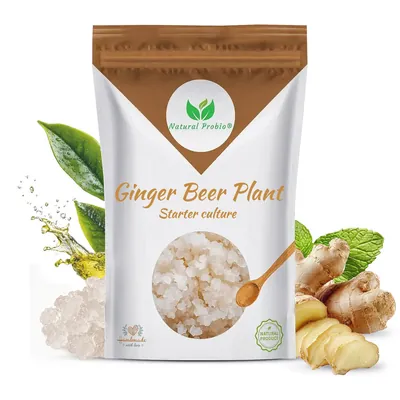 Ginger beer
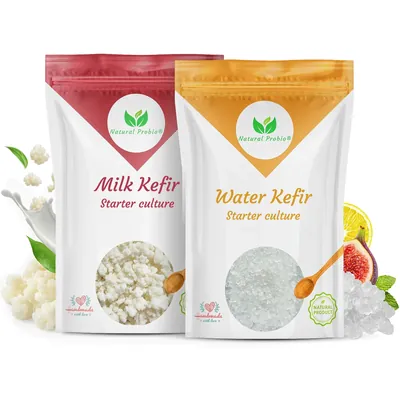 Kefir duo
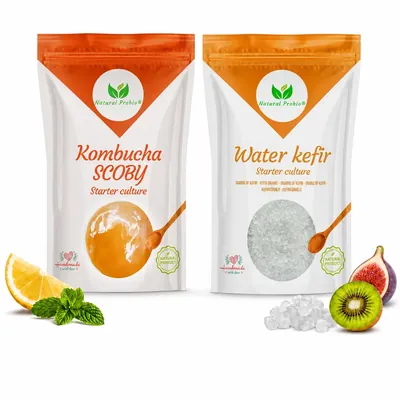 Kefir and kombucha
 Starter kit
 Rennet
Dissolve 60 g of sugar in 1 litre of water, add 2 slices of fresh ginger, 1 dried fig and 20 g of ginger beer plant, and cover the jar with a tea towel. After 24 to 48 hours at room temperature, strain, pour the drink into a swing-top bottle and leave it closed for 48 hours. Then into the fridge. The plant goes straight back to work in fresh sugar water.
What you need for 1 litre
| Ingredient | Quantity | What it does |
|---|---|---|
| Ginger beer plant | 20 g | The live culture that does the work |
| Water | 1 litre | Tap water left to stand, or boiled and cooled |
| Sugar | 60 g (about 4 heaped tablespoons) | Food for the culture |
| Fresh ginger | 2 slices | Heat and aroma |
| Dried fig | 1 | A little extra food and a deeper flavour |
Plain white sugar gives a clear, pale, crisp ginger beer. Golden cane sugar makes it a shade darker, with a soft caramel note. Both work. Choose ginger that is firm, heavy for its size and smells sharp when you scratch the skin with a fingernail. There is no need to peel it: a good wash is enough, and a lot of the aroma sits just under the skin. The fig should be an ordinary unsulphured dried fig from the baking aisle.
For equipment you need a glass jar of about 1.5 litres, a tea towel and an elastic band, a plastic or stainless steel sieve, a funnel and one or two thick glass swing-top bottles. Chlorinated tap water is fine once it has stood in an open jug for a few hours, or been boiled and cooled. The same water rules apply as for water kefir, and they are explained in Water and sugar for water kefir.
Step by step
1. Make the sugar water
Dissolve the sugar in a mug of warm water, pour it into the jar and top up with cool water to 1 litre. The mixture should be at room temperature before the plant goes in, never warm.
2. Add ginger, fig and plant
Cut two slices of ginger about as thick as a pound coin and drop them in with the whole fig. Tip in the 20 g of ginger beer plant. The grains sink to the bottom at first, which is exactly what they should do.
3. Cover
Put a tea towel over the jar with an elastic band, or rest the lid loosely on top. The gas from the first fermentation needs a way out.
4. Leave it alone
Set the jar somewhere calm, out of direct sun, ideally at 20 to 25°C, and leave it for 24 to 48 hours.
5. Taste
From 24 hours, taste with a clean spoon. It should be clearly less sweet than when you started, with a light tang and a faint prickle on the tongue.
6. Strain and bottle
Lift out the fig and the ginger, strain the drink and pour it through the funnel into the bottle. Leave two or three fingers of space under the cap.
7. 48 hours in the bottle
Close the bottle and leave it at room temperature for 48 hours. Then chill it.
What you will see in the jar
Within a few hours, fine threads of bubbles rise from the grains. Now and then a few grains are lifted by the gas, drift up and sink again: a small show to watch over breakfast. The water turns slightly cloudy and smells of ginger, fresh yeast and a hint of cider. All good signs.
How long the first fermentation takes depends mostly on the temperature. In a warm summer kitchen, 24 hours is often enough. In winter, when the house sits at 18 or 19°C, you will usually need the full 48 hours. A shelf in the airing cupboard, a little away from the hot water tank, is the classic answer for a cold kitchen. Do not leave it much longer than 48 hours: the drink turns very sour and the plant runs out of food.
| How it tastes | What it means | What to do |
|---|---|---|
| Like sugar water with ginger | The fermentation has barely started | Wait a few more hours |
| Less sweet, lightly tangy, prickly | Just right | Bottle it |
| Dry and clearly sour | A little too long | Bottle with a teaspoon of sugar per bottle |
In the bottle: flavour and fizz
Ginger beer only gets its real sparkle once the bottle is closed. The yeast keeps working, the gas has nowhere to go, and it dissolves into the drink. When you open it, it hisses, and the glass gets a fine, creamy head.
This is also the moment to make it your own. A slice or two of extra ginger, a teaspoon of grated ginger for more bite, a strip of lemon zest, a squeeze of lime, or a teaspoon of sugar if the first fermentation ran long. Keep the jar simple and do your flavouring here: the plant stays happier that way. A good first variation is the lemon ginger ale, softer and fresher than the basic version.
Ginger beer builds more pressure than most homemade drinks, so treat the bottles with a little respect:
- Use thick glass swing-top bottles made for fizzy drinks, never thin decorative ones or screw-top jars.
- In a warm kitchen, open one bottle over the sink after 24 hours to check, then close it again.
- Once the fizz is where you want it, all the bottles go into the fridge. Cold bottles foam far less when opened.
- Open slowly, with a tea towel over the cap, the first few times.
Straight on to the next batch
The grains stay behind in the sieve. They do not need rinsing: tip them straight into a fresh jar of sugar water with new ginger and a new fig, and the cycle carries on. That gives you fresh ginger beer every two days or so.
With each batch the plant grows a little. When you clearly have more than 20 g, make 2 litres at a time in the same proportions: 40 g of grains, 120 g of sugar, four slices of ginger and two figs. Old ginger and the fig go in the compost every time. How the culture works and what it likes is covered in What is a ginger beer plant?
Taking a break
Going away for a week? Put the grains in a jar of fresh sugar water, close the lid and put it in the fridge. When you get back, strain them and start an ordinary batch. The first one is often a little quiet; by the second, the plant is back to its usual pace.
When it does not go to plan
| What you notice | Usually because | What helps |
|---|---|---|
| Few bubbles in the jar | Too cold, or the plant is still settling in | A warmer spot, never forget the fig, a little patience |
| No fizz in the bottle | Tired rubber seal, too short, too cold | A new seal, the full 48 hours, a warmer spot |
| Gushes when opened | Too warm or too long in the bottle | Chill sooner, open cold, over the sink |
| Too sweet | First fermentation too short | Longer in the jar, up to 48 hours |
| Flat, not much ginger | Old or too little ginger | Fresh, juicy root, an extra slice in the bottle |
The very first batch is often quieter and sweeter than the ones that follow. The grains have just travelled and need to get used to your water and your kitchen. From the second or third batch, they show what they can do. If anything looks really wrong, such as fuzzy mould on the surface, send us a photo and we will help.
Ginger beer at the table
Ice cold, it is a drink to enjoy on its own, or beside a curry, a plate from the barbecue or a Sunday roast. On Bonfire Night, a jug of fiery ginger beer and a slice of parkin make a fine pair. It is also the base for a proper alcohol-free Moscow mule with lime and mint. Like every homemade fermented drink, it contains traces of alcohol, usually under 1%.
Frequently asked questions
Can I use more ginger in the jar?
Do I really need the fig?
Can I use honey instead of sugar?
How long does ginger beer keep in the fridge?
How much plant do I need to start?
Ready to start? Our ginger beer plant comes as 20 g of live grains for £14, with instructions and recipes. Everything else about ginger beer is on the ginger beer page, and if you are torn between two fizzy drinks, read Ginger beer or water kefir?