
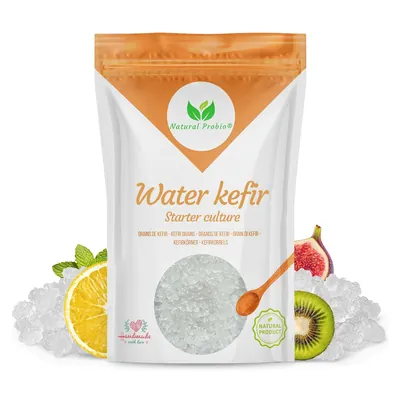
 Water kefir
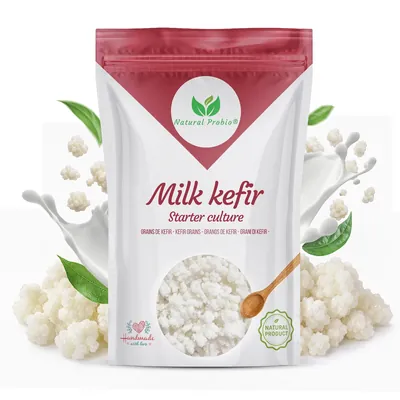 Milk kefir
 Kombucha
 Ginger beer
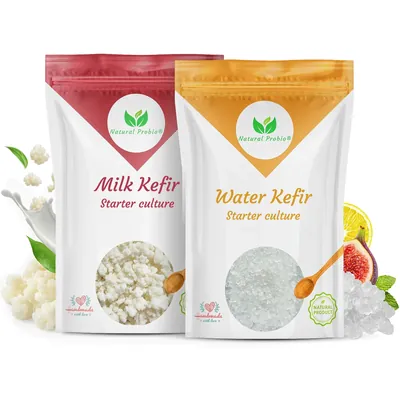 Kefir duo
 Kefir and kombucha
 Starter kit
 Rennet
Yes, milk kefir grains can ferment a plant milk, but they do not grow in it. They live on the natural sugar in animal milk, which soya, oat, almond and coconut drinks do not have. So work with only part of your grains, say 10 g in half a litre of plant drink, then put them back into whole milk for a batch or two before trying again. Soya and coconut give the creamiest results. For a drink with no dairy at all, water kefir is the way to go.
Why the grains prefer animal milk
Milk kefir grains are a small community of lactic acid bacteria and yeasts. Their main food is lactose, the sugar naturally found in cow's, goat's and sheep's milk. Turning it into sourness is what thickens the milk, gives it its fresh tang and builds the soft, springy material the grains are made of.
A soya or oat drink contains other sugars, sometimes added, sometimes from the grain or bean itself. The kefir grains can make use of them: the liquid sours, changes smell and thickens to some extent. But they do not find what they need to grow. After a few batches of plant milk alone, they shrink, slow down and eventually run out of steam.
Hence the golden rule: your grains live in animal milk and go on the odd "outing" into plant milk. Everything about their day-to-day care is in Caring for milk kefir grains.
Soya, oat, almond, coconut: what to expect
Each drink behaves in its own way. The table sums up what usually happens with a plain drink, with no added sugar or flavouring.
| Drink | Texture | Taste | Worth knowing |
|---|---|---|---|
| Plain soya | Thickens fairly well, close to a drinking yoghurt | Fresh and tangy, a faint beany note | The most consistent from batch to batch |
| Coconut (drink, or tinned milk thinned down) | Creamy, coats the spoon | Soft, round, barely sour | Thin tinned coconut milk with water before using |
| Oat | Unpredictable, sometimes stringy or runny | Cereal, slightly sweet and sour | Separates quickly: taste early |
| Almond | Stays runny | Subtle, a little tangy | Not much in it to work on |
| Rice | Very runny | Sweet and sour, fairly neutral | Best kept for smoothies |
Pick a drink without thickeners or flavourings if you really want to taste what the grains have done. A sweetened or vanilla drink ferments too, but the result is harder to judge. Lactose-free milk, by the way, is not in this family at all: it is cow's milk, and your grains behave in it almost as they do in ordinary milk. The best milk for kefir compares all the animal milks, from whole milk to raw milk.
The method, step by step
1. Split your grains
Keep most of your grains in your usual batch of whole milk. Take out about 10 g for the plant milk trial.
2. Start the trial
Put those 10 g into half a litre of plant drink at room temperature, in a glass jar covered with a tea towel. Leave it somewhere between 20 and 25°C, out of direct sun.
3. Taste early
Start tasting after about half a day. A plant drink sometimes turns faster than milk, or splits into two layers. As soon as it smells fresh and has thickened a little, strain it.
4. Let the grains recover
Put the grains back into whole milk for one or two batches. Once they give you a creamy kefir in 24 hours again, they are ready for another trial.
If your grains look tired after a trial, do not worry: a few days of fresh whole milk usually sorts them out. The signs to watch for, such as kefir that will not thicken any more, are in Milk kefir problems.
The taste, drink by drink
Do not expect an exact copy of milk kefir. Think of each trial as a drink in its own right, with its own character.
Soya kefir is like a plain soya yoghurt, only runnier and livelier. It suits savoury food: with garlic, lemon and herbs it becomes a fresh sauce for roast vegetables or falafel. Coconut kefir is the most indulgent, soft and creamy, lovely with mango, pineapple or passion fruit at breakfast. Oat kefir is the most temperamental: some days really pleasant, other days a bit slimy. It is at home on a bowl of porridge or muesli, where the texture matters less.
Almond and rice change very little. They pick up a touch of sourness without really thickening. Blended with a banana, a few dates or a spoonful of peanut butter, though, they make very good smoothies, in the spirit of the banana kefir smoothie.
Keep in mind that your grains live in cow's milk between trials. The drink you end up with therefore still carries traces of milk, which is worth knowing if someone at your table avoids dairy altogether.
The easiest way: mix afterwards
Plenty of people settle on a halfway method that puts the grains at no risk. You make your kefir as usual, 20 g of grains in 1 litre of whole milk for 24 hours. Once strained, you mix it with your favourite plant drink, half and half for example, or one third kefir to two thirds soya.
That way your grains stay in top form, you choose the texture and strength, and you still get the flavour of the oat or coconut. Kefir cut with almond drink makes a light, fresh glass that is lovely well chilled. In porridge, a smoothie or pancake batter you will hardly notice the difference. If you are just starting, the basic recipe is in How to make milk kefir.
No dairy at all? Water kefir
If you want no dairy in the house, milk kefir grains are not the right culture, since they need to go back to animal milk regularly. Water kefir is made for you. Its clear grains live in sugar water with a dried fig and a slice of lemon: 30 g of grains to 1 litre of water and 4 tablespoons of sugar, 24 hours at 20 to 25°C.
The result is not creamy: it is a light, tangy, fizzy drink that you flavour with fruit in season, from rhubarb in spring to hedgerow blackberries in September. The differences between the two kefirs are set out in Water kefir or milk kefir?, and the grains are on the live water kefir grains page, from £11.
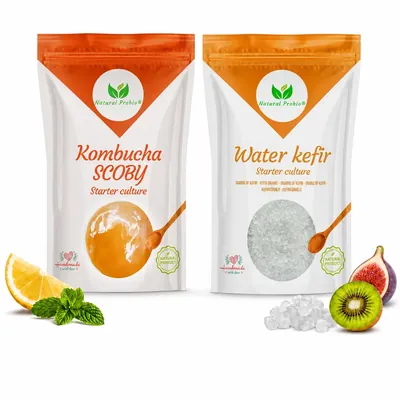
In a household where some drink milk and some do not, the kefir duo keeps everyone happy: milk kefir for some, water kefir for all, and a saving of £4 compared with buying the two separately. For milk kefir alone, our live milk kefir grains come in 10 g and 20 g, from £14.