
 Water kefir
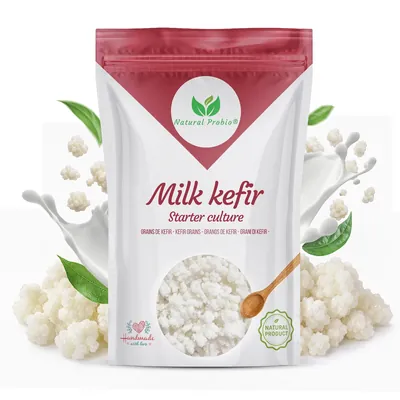 Milk kefir
 Kombucha
 Ginger beer
 Kefir duo
 Kefir and kombucha
 Starter kit
 Rennet
Milk kefir grains, often just called kefir grains, are a live culture of lactic acid bacteria and yeasts living together in a white, springy mass that they build themselves. In milk they turn the milk sugar into a gentle sourness, aroma and a little fizz: that is kefir. They grow with every batch and keep going for years. You cannot make them from scratch; they only grow from existing grains.
What kefir grains look like
Tip a spoonful of kefir grains onto a plate and you see small, irregular florets, white to cream in colour. The smallest are the size of a grain of rice, the biggest as large as a walnut. Their surface is knobbly and curled, just like the florets of a cauliflower. Pick one up and it feels firm, springy and a little slippery, usually with a coat of kefir around it.
They smell of what they make: fresh, sour, a little of yeast or bread dough. Squash one and it breaks into smaller pieces, and those pieces simply carry on living.
What lives inside them
A kefir grain is not a plant and not a mushroom, even if some people call it a kefir plant. It is a community of dozens of kinds of lactic acid bacteria and yeasts. They live together in a firm mass of protein and a jelly-like sugary substance that the bacteria produce themselves. That mass is the grain.
In milk, they work as a team:
- The lactic acid bacteria feed on the milk sugar and turn it into lactic acid. That is what thickens the milk and gives it its fresh, sour taste.
- The yeasts produce a little gas and a trace of alcohol. That is where the faint prickle comes from, and the note of bread dough.
- Together they create aromas you do not get in ordinary soured milk: something fruity, something creamy, a hint of yeast.
After a day at room temperature, a litre of milk has become kefir. Like every homemade fermented drink it contains traces of alcohol, usually under 1%. How to set that batch is in How to make milk kefir.
So many names
| Name | What it means |
|---|---|
| Milk kefir grains | The clearest name, and the one we use |
| Kefir grains | Usually the grains for milk, sometimes also the grains for water |
| Kefir plant | An old-fashioned name; it is not a plant |
| Kefir mushroom | A folk name; it is not a mushroom either |
| Kefir culture, kefir starter | General terms, also used for powdered starters |
Kefir grains and the other cultures
| Culture | Looks like | Lives in | Reusable? |
|---|---|---|---|
| Milk kefir grains | White florets | Milk, at room temperature | Yes, for years, and they grow |
| Water kefir grains | Clear, glassy crystals | Sugar water | Yes, for years |
| Yoghurt culture | A powder or a spoon of yoghurt | Warm milk | A few times, then a new starter |
| Kombucha SCOBY | A rubbery disc | Sweetened tea | Yes, a new layer grows every batch |
The big difference from yoghurt: yoghurt needs warmth, around 40°C, and a starter that tends to weaken after a few rounds. Kefir sets at room temperature, with grains that you lift out and that get stronger over time. The difference from water kefir is explained in Water kefir or milk kefir?, and the full comparison with yoghurt in Kefir or yoghurt?
Where kefir grains come from
Kefir has a long tradition in the Caucasus mountains. There the grains were handed down from generation to generation, kept in leather bags and wooden vessels, and treated as a family treasure that was not given lightly to strangers. How the very first grains came about, nobody knows. They exist, and since then they have kept growing from kitchen to kitchen. The whole story is in The history of kefir.
How kefir grains grow
With every batch the bacteria build a little more grain. The florets get bigger, break apart, and the pieces grow on. In the first weeks that happens slowly, because the grains are getting used to their new home. After that you will see your jar filling up.
- Whole milk helps growth the most.
- A steady rhythm of fresh milk every day keeps them active.
- No rinsing with tap water: it slows them down.
- A temperature between 20 and 25°C is ideal.
When there are too many, your kefir sours faster. What to do with the extra is in Caring for milk kefir grains.
From grains to the British kitchen
What the grains make in a day slips easily into a British kitchen, because it does everything a pot of buttermilk or natural yoghurt does. Kefir is thinner than yoghurt and fuller than buttermilk, it is sour enough to react with the bicarbonate in a batter, and it is there in the fridge every morning. In scones, drop scones or a Pancake Day batter it goes in at the same quantity as buttermilk. Over a bowl of porridge it adds a fresh, creamy tang.
Start with the easy classics: kefir overnight oats are made the night before, and for strained kefir cheese you leave the kefir to drain overnight in a tea towel. On a warm crumpet with a drizzle of honey, it is hard to beat. How the two compare in baking is in Kefir or buttermilk?
Can you make kefir grains yourself?
No. You cannot grow grains from shop-bought kefir, yoghurt or buttermilk. The bacteria that build the grain only pass their work on from grain to grain. Every grain in existence today grew from another grain.
The bottled kefir in the chilled aisle of the supermarket is usually made with a powdered culture, without grains. That is why it tastes different: milder and more uniform than kefir made with grains. It cannot be used to start your own. To make kefir with grains, you start with live grains and keep them going yourself.
Live or dried
Milk kefir grains come in two forms: fresh, in a little milk or kefir, and dried. Both become a live culture again. Dried cultures need a few extra days to get going. Fresh grains are active straight away: the first batch can still be a bit thin, but after a few days the kefir is as it should be.
Our milk kefir grains arrive fresh and alive, in a well-sealed pouch. Our cultures come from traditional methods: unique and vigorous.
How many grains do you need?
| Grains | Kefir per day | Suits |
|---|---|---|
| 10 g | Half a litre | One person, or a gentle start |
| 20 g | 1 litre | Two people, or anyone who bakes a lot with kefir |
Because the grains grow, your yield grows with them. With 10 g you often have enough for a full litre after a few weeks. If you would like to make water kefir alongside, have a look at the kefir duo.
Frequently asked questions
Are kefir grains a mushroom?
Can you eat kefir grains?
Can I put milk kefir grains in sugar water?
How long do kefir grains live?
Why are my grains a bit yellow?
Ready to make your own kefir? Our live milk kefir grains come in 10 g or 20 g, from £14. Everything about the daily batch is in the complete milk kefir guide.