
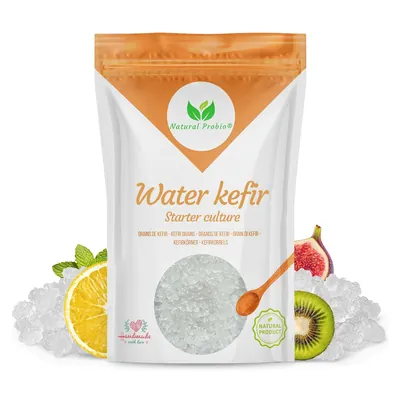
 Water kefir
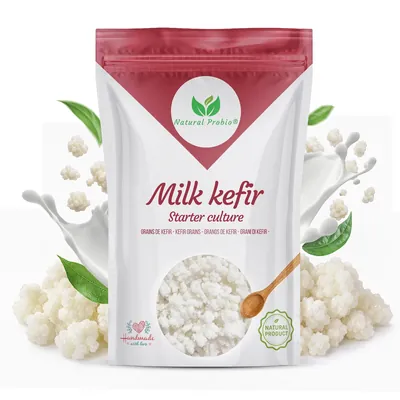 Milk kefir
 Kombucha
 Ginger beer
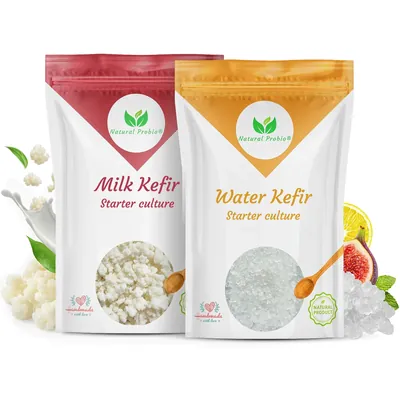 Kefir duo
 Kefir and kombucha
 Starter kit
 Rennet
Put 30 g of water kefir grains in 1 litre of water with 4 tablespoons of sugar (about 60 g), 1 dried fig and 1 slice of lemon. Cover with a tea towel and leave it for 24 hours at 20 to 25°C. Strain, bottle the drink with a little fruit if you want more fizz, and put the grains straight back into fresh sugar water. That is one litre a day, every day, for as long as you look after them. With 60 g of grains you make 2 litres.
What is water kefir?
Water kefir is a fermented drink you make at home from water, sugar, a bit of fruit and live grains. The grains look like small, translucent lumps of crystallised sugar: soft, slightly rubbery, anything from the size of a grain of rice to a pea. Inside them, yeasts and lactic acid bacteria live together. They feed on the sugar and turn it into gentle acidity, aroma and fine bubbles.
What ends up in your glass is a long way from the fizzy drinks on the supermarket shelf. Water kefir is less sweet and far fresher, with a light tang and a fruity background that changes with whatever you add to it. Freshly strained, it has a soft sparkle. After a second fermentation in a closed swing-top bottle, it fizzes properly and looks just as festive in a wine glass as anything with a cork.
There is no milk in it, no tea, and no gadget to buy. A jar, a sieve and a bottle will do. Like every homemade fermented drink, water kefir contains traces of alcohol, usually under 1%.
Water kefir grains, tibicos, Japanese water crystals: all the same?
These grains go by a surprising number of names. You will see water kefir grains, sugary kefir grains, tibicos, water kefir crystals and, in older cookbooks, Japanese water crystals. We call them water kefir grains, but every one of those names points to the same live culture for sugar water.
Be careful with plain "kefir grains", though. That name is also used for the white, cauliflower-like grains that live in milk and make something completely different: milk kefir. Water kefir grains are clear and glassy; milk kefir grains are white and creamy. Where the names come from, what the grains are made of and why they multiply is all in the guide What are water kefir grains?
What you need to get started
The list is short, and most of it is already in your kitchen cupboards.
| Ingredient or equipment | Quantity | What it is for |
|---|---|---|
| Water kefir grains | 30 g | The live culture that does the work |
| Water | 1 litre | The base of the drink |
| Granulated white or cane sugar | 4 tablespoons (about 60 g) | Food for the grains |
| Dried fig | 1 | Flavour, and a handy signal that the batch is ready |
| Lemon | 1 slice | Freshness and a light sharpness |
| Glass jar | A little over 1 litre | Room for the drink and the grains |
| Sieve | Plastic or stainless steel | Separates the grains from the drink |
| Clean tea towel and an elastic band | 1 | Covers the jar without sealing it |
| Swing-top bottle | 1 litre | For the second fermentation with fruit |
With 60 g of grains you make 2 litres a day: simply double the water, sugar and fruit. That suits a household of several drinkers, or anyone who likes two flavours on the go in the fridge. Both sizes are on the water kefir grains page, starting at £11.
The basic method, step by step
This is the batch you repeat every day. Two minutes of work; the grains do the rest.
1. Dissolve the sugar
Stir 4 tablespoons of sugar into 1 litre of water until nothing is left on the bottom of the jar.
2. Add the fruit and grains
In go the dried fig, the slice of lemon and the 30 g of grains. Tea towel over the top, elastic band around the neck.
3. Leave it to ferment
24 hours at 20 to 25°C, out of direct sunlight and away from the hob.
4. Strain and start again
Once the fig floats, strain. The drink goes into a bottle, the grains go straight into fresh sugar water.
Taste as you strain. Still very sweet? Give the next batch a few more hours. Too sharp? Strain earlier. After three or four batches you will know exactly where your sweet spot is. Every step, with the details and the small decisions, is laid out calmly in the guide How to make water kefir.
The first few days with your grains
The grains arrive alive, in their own liquid, but they have spent a few days in a pouch. They need one or two batches to settle into your kitchen: your water, your sugar, your temperature. So if the first litre is a bit flat or tastes more of sugar water than anything else, that is completely normal.
Open the pouch as soon as it arrives, put the grains into sugar water without rinsing them, and stick to the 24 hours. From the second or third batch the fig rises sooner, tiny bubbles cling to the glass and the jar smells fresh, somewhere between green apple and a soft cider.
What is normal at this stage and what is not, whether the liquid may turn cloudy, and when it is worth sending us an email: all of that is in the guide Water kefir: the first days.
Which water, which sugar?
Two ingredients that make a real difference. The good news is that you do not need to buy anything special.
| Ingredient | Works well | Best avoided |
|---|---|---|
| Water | Tap water left to stand or boiled and cooled, still mineral water, a private supply that is fine to drink | Distilled water, water from a softener |
| Sugar | White sugar, cane sugar, a mix of the two | Sweeteners, stevia, sugar substitutes |
| Fruit in the first fermentation | Dried fig, a slice of lemon | Lots of fresh fruit that breaks down quickly |
British tap water is treated with chlorine, which the grains do not love. Let a jug stand uncovered for a few hours, or boil the kettle and let it cool, and the problem is gone. Hardness varies a lot around the country. In London, the South East and East Anglia the water is usually hard and chalky (you will know from the limescale in your kettle), and the grains tend to enjoy that. In Scotland, Wales and the North West, from the Lake District to Manchester, it is often very soft, and grains can stay small. Your local water company will tell you the hardness for your postcode on its website. If your grains are not growing, try a still mineral water for a while. Some rural homes are on a private water supply, which generally suits water kefir well as long as the water is fine for drinking.
As for the sugar, the grains live on it and cannot do anything with sweeteners. Do not worry about the amount: a large part of it is eaten during fermentation, and the finished drink is only lightly sweet. Golden caster or cane sugar gives a rounder, darker drink; ordinary granulated sugar lets the fruit come through more clearly. Light muscovado, honey, golden syrup, coconut sugar and the rest are covered in the guide Water and sugar for water kefir.
The second fermentation: how to get real fizz
Freshly strained water kefir is gently sparkling. The proper fizz comes in the second fermentation. You pour the drink into a swing-top bottle with some fruit or juice, close it and leave it at room temperature for 24 to 48 hours. The yeasts keep working, the gas has nowhere to go, and it dissolves into the drink.
- Leave two or three fingers of space at the top of the bottle.
- A few strawberries, a handful of raspberries, two slices of ginger or a splash of juice is plenty.
- In a warm kitchen, open the bottle over the sink after 24 hours to check the pressure.
- Then into the fridge: the cold slows everything down and keeps the fizz in.
Which bottles to use, how much fruit to add and how to control pressure and sweetness are all in the guide Water kefir: the second fermentation.
Recipes through the year
The second fermentation is where water kefir becomes your own drink. Every season brings its own fruit, and some of the best of it grows in the garden or the hedgerow.
| Season | Idea | Recipe |
|---|---|---|
| Spring | Garden rhubarb, tart and pink | Rhubarb water kefir |
| June | Elderflower from the hedgerows, fragrant and summery | Elderflower water kefir |
| Summer | Strawberries, from the garden or the farm stall | Strawberry water kefir |
| Hot days | Frozen into ice lollies, for children and grown-ups | Water kefir ice lollies |
| Autumn and winter | Lemon and fresh ginger | Lemon and ginger water kefir |
Rhubarb water kefir is a proper spring classic: a few stalks, a spoon of sugar, two days in the bottle, and you have a pink, sharp drink with a lovely fizz. In June, a couple of elderflower heads picked on a dry morning turn it fragrant, almost like a cordial with bubbles. High summer belongs to strawberries, and on the rare properly hot day you can pour the drink into lolly moulds. When the evenings draw in, lemon and ginger put some warmth back in the glass.
If you want to go beyond water kefir, there are other ways to make your own sparkling lemonade, all set out in Homemade fermented lemonade.
Caring for the grains and taking a break
Well looked after, water kefir grains keep going for years. The rules are simple: feed them regularly, do not let them get too hot, avoid metal that rusts, and give them fresh sugar water every batch.
- Every day: strain every 24 hours and start a new batch. Forgetting a day is not a disaster.
- A short break: away for a week? Put the grains in fresh sugar water in the fridge.
- After the break: one or two ordinary batches and they are back in their rhythm.
- Growth: the grains multiply. Use the extra to make more litres, or give a jar to someone who wants to start.
How to rinse the grains (usually you do not need to), how to prepare them for a long summer holiday, and how to tell lively grains from tired ones are covered in the guide Caring for water kefir grains.
British kitchens can be cool for a good part of the year, and a batch at 17°C simply takes longer. In winter, a shelf in or near the airing cupboard or in the warmest room helps a lot. More ideas for keeping cultures happy through the cold months are in Fermenting in winter.
Fitting water kefir into your day
Most people start a batch in the morning while the kettle boils: strain yesterday's jar, grains into fresh sugar water, fig and lemon in, tea towel on. The strained kefir goes into the swing-top bottle with some fruit and is sitting fizzy in the fridge by the following evening. If evenings suit you better, just turn the routine around.
A fixed spot on the worktop helps, not beside the cooker and not on a sunny windowsill. Two jars used in turn make washing up easier. In summer, when the kitchen warms up, check the jar a little earlier; in winter, let it run longer.
At a birthday, a christening or an afternoon in the garden, a jug of water kefir with ice, cucumber and mint is an easy choice for anyone who is driving or not drinking. Raise a glass and say cheers.
When things go wrong
Most problems have a simple cause: temperature, water, sugar or patience. Here are the usual suspects.
| What you see | Common cause | What helps |
|---|---|---|
| Hardly any bubbles | First batches, a cold kitchen | Patience, a warmer spot, a second fermentation in the bottle |
| Tastes very sweet | Fermented too briefly or too cold | Leave it a few hours longer |
| Tastes very sour | Fermented too long or too warm | Strain earlier, find a cooler spot in summer |
| Drink turns syrupy or stringy | Culture out of balance | Change the water, leave out the lemon once, give it a few batches |
| Grains not growing | Very soft water, little mineral content | Try a different water, keep the fig in |
Each of these, plus a few rarer ones, is explained in detail in the guide Water kefir problems and how to fix them. Many beginners make the same handful of mistakes, and you will find them in Beginner kefir mistakes. Still stuck? Write to us and we will look at it with you personally.
Where to buy water kefir grains
Tesco, Sainsbury's, Waitrose, Asda and M&S sell ready-made kefir drinks and kombucha in bottles. Live grains for making your own batches are not on their shelves. You can order them from us: 30 g or 60 g of live water kefir grains, sent in their own liquid, with instructions and recipes.
Our cultures come from traditional methods: unique and vigorous. You can pay by Visa or Mastercard debit or credit card, Apple Pay, Google Pay, PayPal or Klarna (pay in 3). Standard tracked delivery to your door costs £4.90, is free from £35 and takes 3 to 6 working days across the UK; express tracked delivery costs £14.90, in 3 to 5 working days, with Royal Mail handling the last leg. All prices include VAT. What to look out for when buying, which size suits you and how the grains travel are covered in the guide Buying water kefir grains and on Delivery and payment. What a litre ends up costing you is worked out in The cost of making kefir at home.
Water kefir, milk kefir or ginger beer?
If you are torn between cultures, think about what you like to drink. Water kefir is fruity and fresh, dairy-free, and takes the place of fizzy drinks in the fridge. Milk kefir is creamy and tangy, more of a breakfast thing, close to buttermilk or a drinking yoghurt. Ginger beer is spicy, smells of ginger and has a lively fizz.
The two kefirs side by side are compared in Water kefir or milk kefir?, its spicy cousin in Ginger beer or water kefir? and kombucha in Kefir or kombucha? If you want both kefirs, take the kefir duo and save £4. The water kefir and kombucha set lets you brew a kombucha alongside your water kefir, and the complete fermentation starter kit gets you going with all three at once. Not sure yet? Which ferment suits me? helps you decide in two questions.
How to enjoy it
Ice cold with a slice of lemon, water kefir is already a small treat. But it can do more:
- As an alcohol-free aperitif in a wine glass, with a sprig of rosemary.
- Half and half with fresh orange juice at a long Sunday breakfast.
- In a big jug at a barbecue, with cucumber slices and mint.
- In the kitchen, splashed over a fruit salad or stirred into a sorbet.
All the ideas are in the recipes, and each guide below goes deeper into one step. New to fermenting? Read Fermented drinks for beginners too.