
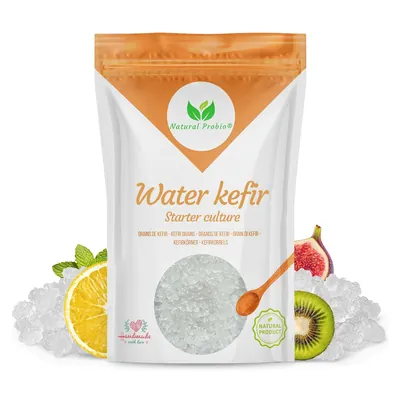
 Water kefir
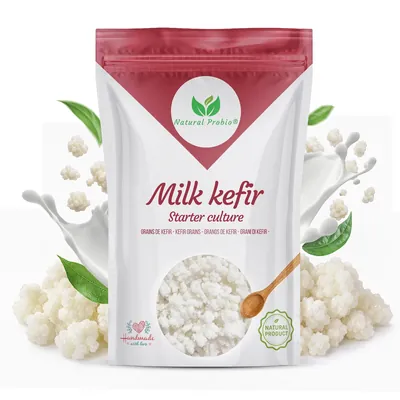 Milk kefir
 Kombucha
 Ginger beer
 Kefir and kombucha
 Starter kit
 Rennet
Water kefir and milk kefir are two different cultures. Water kefir grains are clear and angular and work in water with sugar, a dried fig and lemon: after 24 hours you have a light, fruity drink that turns fizzy in the bottle with fruit. Milk kefir grains are white and look like cauliflower florets. They work in whole milk: after 24 hours you have a fresh, sour, drinkable dairy, a little thicker than buttermilk. Water kefir is your lemonade, milk kefir your breakfast and your baking. You cannot swap the cultures, but you can easily keep both.
Two cultures with the same surname
The word kefir causes no end of confusion. Labels and recipes often just say "kefir", when it can mean two quite different things. In the supermarket, kefir is nearly always milk kefir in a bottle. If you want to make your own, you choose between two cultures.
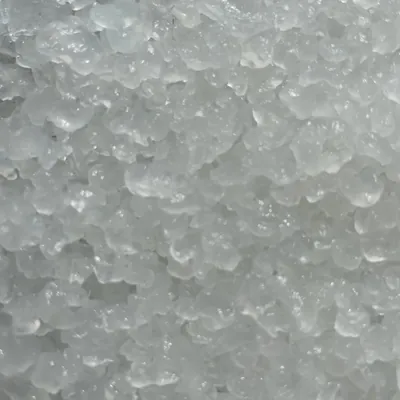
Water kefir grains are also called sugary kefir grains, tibicos or Japanese water crystals, and sometimes simply kefir grains. They are clear, white to pale gold, smooth and slightly angular, like little pieces of crystallised sugar. They live on sugar in water. What exactly they are is explained in What are water kefir grains?
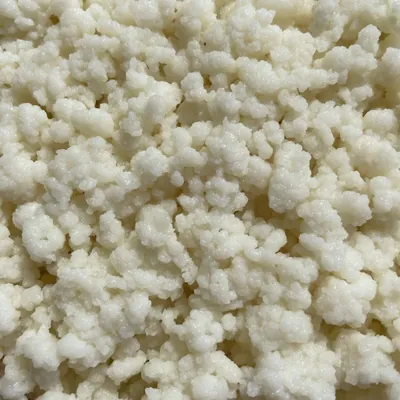
Milk kefir grains are white to cream, soft and springy, and look like tiny cauliflower florets. They live on the milk sugar in milk. More about them in What are milk kefir grains?
Each culture has its own make-up. Milk kefir grains in sugar water go downhill, and water kefir grains can do nothing with milk. So you are not choosing between two ways of making the same thing, but between two different drinks.
The differences at a glance
| Water kefir | Milk kefir | |
|---|---|---|
| Culture | Clear, angular crystals | White grains like cauliflower florets |
| Per litre | 30 g grains, 4 tablespoons sugar (about 60 g), 1 dried fig, 1 slice of lemon, 1 litre water | 20 g grains, 1 litre whole milk |
| Fermentation | 24 hours at 20 to 25°C | 24 hours at 20 to 25°C |
| Second fermentation | 24 to 48 hours in a closed swing-top bottle, with fruit | Not needed, nice with zest or fruit |
| Taste | Lightly sweet, fresh, fruity | Fresh and sour, creamy, a little prickle |
| Texture | Clear, like lemonade | Pourable, a little thicker than buttermilk |
| Dairy | No | Yes |
| Bigger or smaller batch | 30 g makes 1 litre, 60 g makes 2 litres | 10 g makes half a litre |
Taste and uses
Water kefir is a thirst-quencher. Cold from the fridge, in a glass with ice and a slice of lemon, or flavoured with whatever the season brings: rhubarb from the garden in April and May, elderflower from the hedgerows in June, strawberries in summer, blackberries in September. It is at its best on a warm afternoon in the garden, with lunch, or as an alternative to fizzy drinks at a birthday party or a summer barbecue. Ideas are in recipes such as the elderflower water kefir and the rhubarb water kefir.
Milk kefir belongs at breakfast and in the kitchen. Over muesli or granola, stirred through porridge, in a smoothie or straight from the glass. Drained, it becomes a soft, tangy spread for toast or crumpets. And it is the perfect stand-in for buttermilk: scones, drop scones and pancakes all rise just as they should with kefir in the same quantity. Recipes such as the banana kefir smoothie and strained kefir cheese show what it can do, and the baking side is covered in Kefir or buttermilk?
incl. VAT, plus delivery (free from £35)
Rhythm and care
This is where they are actually very alike. Both work on a daily rhythm: after about 24 hours you strain the culture and set it going again. It takes a couple of minutes, easiest at a fixed time, for example in the morning while the kettle boils.
Water kefir is strained through a plastic sieve, the grains can be given a quick rinse if needed, and they go into fresh sugar water with a new fig and a slice of lemon. How that works is in How to make water kefir.
Milk kefir is poured through a sieve, you stir the thick kefir through with a spoon, and the grains go straight into fresh milk. No rinsing is the rule here. The method is in How to make milk kefir.
Going away for a few days? Both cultures can wait in the fridge, covered: the water kefir grains in fresh sugar water, the milk kefir grains in fresh milk. When you get back, they need one or two batches to get back up to speed. In a cold British winter both slow down too, and both appreciate a warmer spot in or near the airing cupboard.
Which milk, which sugar?
For water kefir, ordinary granulated sugar or cane sugar in tap water works. British tap water is chlorinated, so let it stand for a few hours or boil and cool it first. Hard water in the South East, London and East Anglia and soft water in Scotland, Wales and the North West both work, with small differences. The water and the sugar shape a lot of the flavour, and there is a separate guide on them: Water and sugar for water kefir.
Milk kefir works best with whole milk, fresh from the fridge or raw from a farm. Goat's milk works well too, see Goat's milk kefir. What each milk gives you is in Which milk for kefir? If you do not drink dairy, water kefir is the more natural choice. What can and cannot be done with plant milk is in Kefir with plant milk.
What it costs
With both, you buy the culture once and use it again and again. For water kefir, all you pay for per litre after that is a little sugar, a dried fig and a slice of lemon. For milk kefir, the milk is your main cost: a litre of whole milk a day, or half a litre if you start with 10 g. Both cultures also grow. After a few weeks you will have more grains than you need, so you can make bigger batches. A worked example with supermarket prices is in The cost of making kefir at home.
How to choose
- You like lemonade or fizzy drinks, but want something less sweet: water kefir.
- You have yoghurt, porridge or muesli every morning: milk kefir.
- You do not drink dairy: water kefir.
- You bake scones or pancakes and are tired of running out of buttermilk: milk kefir.
- You love making summer drinks and ice lollies with fruit from the garden: water kefir.
- You want both: the kefir duo, with water kefir and milk kefir in one parcel.
Both side by side
Plenty of people keep both. The work fits into one morning routine: first strain the water kefir and set it going again, then the milk kefir. Use a separate jar, sieve and spoon for each culture, and keep the jars a little apart. That way they never get mixed up and each stays in its own balance.
If you would like kombucha too, read Kefir or kombucha?, where all three are compared. And anyone who wants to try everything can get water kefir, milk kefir and kombucha in one go with the complete fermentation starter kit.
Frequently asked questions
Can I put milk kefir grains in sugar water?
Which one is easier?
Does milk kefir taste like buttermilk?
How much do I need to start?
Choose your culture: water kefir grains from £11, milk kefir grains from £14, or both together in the kefir duo for £27, saving £4. Standard tracked delivery is £4.90, free from £35, VAT included. Still undecided? The ferment finder will help.
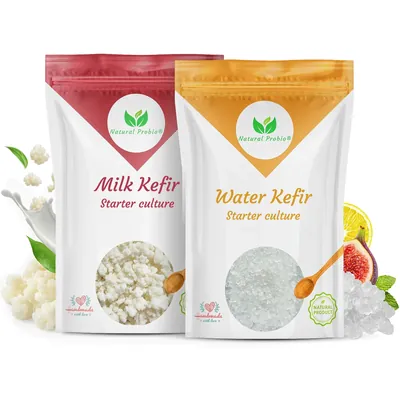
Kefir duo: water kefir and milk kefir
Water kefir 30 g + Milk kefir 20 g. One creamy, one fizzy, every day.
You save £4 compared with buying separately
£27£54 / 100 g
incl. VAT, plus delivery (free from £35)