
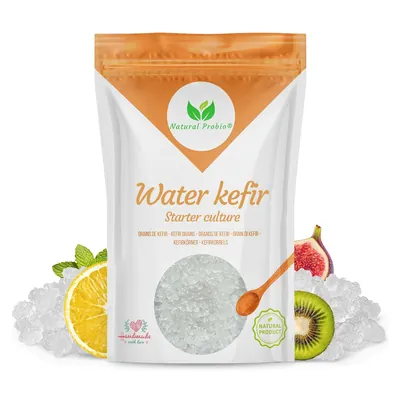
 Water kefir
 Milk kefir
 Kombucha
 Ginger beer
 Kefir duo
 Kefir and kombucha
 Starter kit
 Rennet
Dissolve 4 tablespoons of sugar (about 60 g) in 1 litre of water, add 1 dried fig, 1 slice of lemon and 30 g of water kefir grains, and cover the jar with a tea towel. After 24 hours at 20 to 25°C, strain it. The drink goes into a bottle and then the fridge; the grains go straight back into fresh sugar water. With 60 g of grains you make 2 litres the same way.
What you need
Making water kefir takes about two minutes a day. The grains do nearly all of the work, and you supply the sugar water. For one litre you need:
- 30 g of live water kefir grains, in their own liquid.
- 1 litre of water: tap water that has stood for a few hours or been boiled and cooled, or a still mineral water.
- 4 tablespoons of sugar, which is roughly 60 g. Ordinary granulated sugar, golden caster or cane sugar, or a mix.
- 1 dried fig, ideally a soft one without sulphites.
- 1 slice of lemon, peel and all, so an unwaxed lemon is best.
For equipment: a glass jar holding a little over a litre (a big Kilner-style jar or an old pickle jar does nicely), a plastic or stainless steel sieve, a clean tea towel or a square of kitchen paper with an elastic band, a long spoon for stirring, and a bottle for the finished drink. A swing-top bottle is ideal, because you will want it later for the second fermentation.
Step by step
1. Make the sugar water
Put the sugar in the jar, pour in a splash of warm water from the kettle and stir until it has dissolved. Top up with cold water to 1 litre. That way the sugar water is cool, or barely lukewarm, by the time the grains go in.
2. Add the fig and lemon
Drop in the dried fig and the slice of lemon. The fig brings flavour and mineral salts, the lemon a clean, sharp note that keeps the batch fresh.
3. Add the grains
Tip the grains and their liquid from the pouch into the jar. Do not rinse them for the first batch: that liquid is part of the culture and helps it get going.
4. Cover the jar
Tea towel or kitchen paper over the top, elastic band round the neck. The jar has to breathe, so do not screw a lid on at this stage.
5. Leave it for 24 hours
Find it a regular spot in the kitchen, at 20 to 25°C and out of direct sunlight. No stirring needed.
6. Strain and start again
Lift out the fig and lemon, then pour the drink through the sieve into a jug or bottle. The grains go straight back into a clean jar with fresh sugar water, a new fig and a new slice of lemon.
How to tell your water kefir is ready
The clock is a starting point, but the jar tells you far more. These are the signs to look for:
- The fig floats. It swells up with gas and rises to the surface. This is the classic sign that the work is done.
- There are bubbles. Fine beads cling to the glass and a thin ring of foam forms around the edge.
- The drink is cloudy. Slightly milky, or golden if you use cane sugar.
- It smells fresh. A little like green apple, pear or a mild cider, with a hint of yeast.
- It tastes less sweet than the sugar water. Lightly tart, with a bit of sweetness still there.
In the first few days after the grains arrive, you will not see all of these yet. That is expected: they need time to settle into your water and your kitchen. What to look for in that first week is set out in Water kefir: the first days.
Adjusting the flavour
The basic recipe is where you start, not where you have to stay. After a few batches you will know whether you like it sweeter or sharper. Change one thing at a time, so you know which change did what.
| You want | What to do |
|---|---|
| Sweeter and milder | Strain a few hours earlier, or move the jar somewhere slightly cooler |
| Fresher and less sweet | Leave it a few hours longer |
| A fuller flavour | Swap some of the white sugar for cane sugar |
| More fizz | A second fermentation in a closed swing-top bottle |
| More fruit flavour | Add fruit in the bottle, not in the jar with the grains |
Which sugar gives which taste, and why one tap water works better than another, is covered in detail in Water and sugar for water kefir.
Making more, or less
The ratio never changes: 30 g of grains to 1 litre of water. If you want to drink more, double everything.
| Grains | Water | Sugar | Fig and lemon | Jar |
|---|---|---|---|---|
| 30 g | 1 litre | 4 tablespoons (about 60 g) | 1 fig, 1 slice | A little over 1 litre |
| 60 g | 2 litres | 8 tablespoons (about 120 g) | 2 figs, 2 slices | A little over 2 litres |
The grains grow a little with every batch. After a few weeks, weigh them on the kitchen scales. Once you have 60 g, either make 2 litres from then on or split them between two jars and flavour each bottle differently. Too many grains in too little water quickly gives a sour, rather flat drink.
Fitting it into your week
Water kefir works best as a habit. A lot of people do it first thing in the morning while the kettle boils for the tea: strain yesterday's jar, grains into fresh sugar water, done before the cup is poured. Others do it in the evening after the washing up. Either is fine, as long as you keep roughly the same time.
Two jars make life easier. While one is working, the other is clean and waiting. You do not need to scrub the jar with washing-up liquid every day; a good rinse with hot water is enough, with a proper wash once a week, rinsed well afterwards.
Temperature sets the pace. On a warm summer day, when the kitchen reaches 25°C or more, a batch can be ready in 18 to 20 hours. In winter, in a kitchen at 18°C, it can take 36. Many British houses run cool for much of the year, so a shelf in or near the airing cupboard or the warmest corner of the kitchen makes a real difference, as long as the jar is near the warmth and not sitting on top of a radiator. More ideas are in Fermenting in winter.
Glass, metal and plastic
You will often read that water kefir must never touch metal. It is not that strict. A stainless steel sieve or spoon is no problem for the few seconds it takes to strain. What you avoid is aluminium, copper and anything that might rust, and leaving the grains for hours in a metal pot. For the fermentation itself, glass is best: you can see what is happening, it does not hold smells, and it is easy to clean.
A plastic sieve works just as well. Pick one with a fine mesh, so that even the smallest grains stay out of your bottle.
Common mistakes in the first batches
- Sugar water that is too hot. Always let it cool to lukewarm at most.
- Sweetener instead of sugar. The grains cannot live on it.
- Screwing the lid on. In the first fermentation the gas needs to escape.
- Judging too soon. The first two or three batches are often flat. That is the grains adjusting, not a failure.
- Leaving it too long. After two or three days without fresh sugar water, the grains go hungry and the drink turns sour.
- A sunny windowsill. Too warm and too bright. A spot on the worktop out of the sun is better.
Still not right after that? Each problem, with its cause and its fix, is in Water kefir problems and how to fix them.
What to do with the strained kefir
You can drink it straight away. Freshly strained, water kefir is gently sparkling and tart, with the fig and lemon in the background. Kept in a closed bottle in the fridge, it stays at its best for a few days. It slowly becomes a little drier, because fermentation never quite stops in the cold.
For real fizz, put a handful of fruit or a splash of juice in a swing-top bottle, pour the kefir over it and leave the bottle closed on the worktop for 24 to 48 hours, then move it to the fridge. Good places to start are lemon and ginger water kefir, rhubarb water kefir in spring and elderflower water kefir in June.
Like every homemade fermented drink, water kefir contains traces of alcohol, usually under 1%. The longer and warmer it stands, the more that can creep up.
Frequently asked questions
Do I need to rinse the grains after every batch?
Can I leave out the fig?
How long can I leave a batch?
Can I reuse the lemon slice?
Is there alcohol in my water kefir?
No grains yet? Our live water kefir grains start at £11, in 30 g or 60 g, with instructions and recipes. Standard tracked delivery is free from £35 anywhere in the UK, and all prices include VAT. Everything else about water kefir is gathered in the complete water kefir guide.