
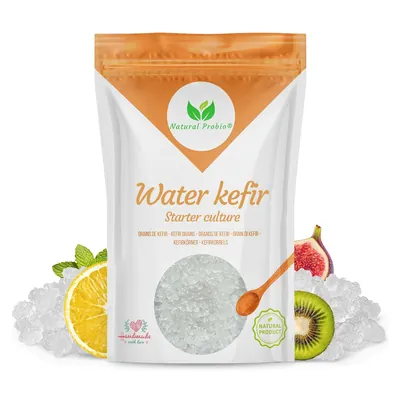
 Water kefir
 Milk kefir
 Kombucha
 Ginger beer
 Kefir duo
 Kefir and kombucha
 Starter kit
 Rennet
Water kefir grains are a living culture of lactic acid bacteria and yeasts, held in a translucent, jelly-like mass that the bacteria make themselves. In sugar water they turn the sugar into gentle acids, aroma and fizz. They are also called sugary kefir grains, water kefir crystals, tibicos or Japanese water crystals. You cannot make them from scratch: they only ever grow from existing grains.
What they look and feel like
Tip a pouch of water kefir grains into a bowl and you see a little heap of translucent, irregular lumps. Some are as small as a grain of rice, others as big as a pea or even a hazelnut. They have a slight sheen and are white, greyish or golden, depending on the sugar they have been living in.
Pick one up between finger and thumb and it feels firm but yielding, somewhere between a jelly sweet and a piece of set jelly. Press harder and it breaks into smaller pieces. That is no problem: every piece lives on and grows again. They smell lightly sour, a bit yeasty, sometimes of apple or cider.
Despite the name, then, they are not crystals in the sense of sugar or salt. The word comes purely from how they look.
What lives inside a grain
Every grain is a small community. Several kinds of lactic acid bacteria and yeasts live together, and they depend on each other. Some of the bacteria turn sugar into a firm, jelly-like substance: that is what the grain itself is made of. The other bacteria and the yeasts live in and on that mass.
Put the grains into sugar water and everyone gets to work:
- The yeasts eat sugar and make carbon dioxide and a little alcohol. That is where the bubbles come from, along with the smell that reminds you of cider.
- The lactic acid bacteria make mild acids. They give the fresh, tart taste and keep the drink stable.
- Together they create aromas you never put in the jar: notes of pear, apple, sometimes something close to elderflower.
After a day, the sugar water has become water kefir: less sweet, slightly cloudy, fresh and sparkling. Like every homemade fermented drink, it contains traces of alcohol, usually under 1%. How to make that daily batch is explained in How to make water kefir.
So many names for one culture
Search for water kefir and you will meet a whole list of names. They all mean the same thing.
| Name | Where you will come across it |
|---|---|
| Water kefir grains | The name we use, and the most common one in the UK |
| Water kefir crystals | After their glassy, translucent look |
| Sugary kefir grains | Used to tell them apart from the grains for milk |
| Tibicos | An old name you still see in recipes and older books |
| Japanese water crystals | An old-fashioned name many people remember from a grandparent's kitchen |
| California bees | An old folk name, sometimes also used loosely for the ginger beer plant, which is in fact a different culture |
Nobody knows exactly where the grains first came from. There are stories about cactus plants in Central America, but nothing certain. What is certain is that they have been handed on from kitchen to kitchen for generations, and the name Japanese water crystals probably says more about how exotic they once seemed than about where they started out.
Water kefir grains beside the other cultures
Home fermenting uses a handful of different cultures. They have things in common, because they are all living communities of bacteria and yeasts, but each one works in its own food.
| Culture | Looks like | Lives in | Becomes |
|---|---|---|---|
| Water kefir grains | Translucent lumps, like crystallised sugar | Sugar water | A fruity, sparkling drink |
| Milk kefir grains | White florets, like cauliflower | Milk | Creamy, tangy drinking kefir |
| Kombucha SCOBY | A rubbery disc | Sweetened tea | Tart, sparkling tea |
| Ginger beer plant | A white, grainy sludge | Sugar water with ginger | Spicy homemade ginger beer |
Water kefir and the ginger beer plant are the closest relatives: both live in sugar water and both are ready in a day or two. The ginger beer plant wants fresh ginger in every batch and gives a drier, spicier drink; water kefir is softer and fruitier. The SCOBY is the odd one out, working slowly over a week in sweet tea. Milk kefir grains share the name but nothing else: they need milk. Not sure which culture suits you? Read Water kefir or milk kefir?, Ginger beer or water kefir? and Kefir or kombucha? If you already drink tea by the pot, everything about kombucha is worth a look too.
How the grains grow
Well fed, water kefir grains grow. The bacteria keep making new jelly, the grains get bigger, break apart on their own, and the pieces carry on growing. After a few weeks you may weigh several grams more than you started with.
How fast that happens depends mainly on three things:
- The hardness of the water. Hard tap water or a still mineral water helps; very soft or filtered water slows growth down.
- The sugar. A spoonful of golden caster sugar in the mix often suits them.
- The temperature. They grow best between 20 and 25°C.
More on water and sugar is in Water and sugar for water kefir, and the rest of their care in Caring for water kefir grains.
Can you make water kefir grains yourself?
No. You cannot get grains to appear from sugar water, fruit or a bottle of kefir from the shop. The bacteria that form the jelly live only in the grains themselves and pass their work on from grain to grain. Every grain in existence today grew from another grain.
That is also why you will not find them in Tesco, Sainsbury's, Waitrose, Asda or M&S. What they stock is kefir in bottles, as a ready-made drink. A living culture that you keep going yourself is something you buy as grains in their own liquid. What to look out for when you buy is covered in Buying water kefir grains.
How many grains do you need?
The standard ratio is 30 g of grains to 1 litre of water, with 4 tablespoons of sugar (about 60 g), a dried fig and a slice of lemon. After 24 hours at 20 to 25°C you have a litre of water kefir.
| You drink per day | Grains | Suits |
|---|---|---|
| 1 litre | 30 g | One or two people, a glass or two a day |
| 2 litres | 60 g | A family, or two flavours in the fridge at once |
Because the grains grow, you can start small. After a few weeks you often have enough to use more water or start a second jar. Too many grains in too little water makes the drink sour quickly, so weigh them on the kitchen scales now and then.
Wet and alive, or dried
Water kefir grains are sold in two forms: wet, in their own culture liquid, or dried. Both can become a living culture again. Dried cultures need a few extra days to get going, because they have to wake up first. Wet grains are active straight away and often give a sparkling drink within a few batches.
Our water kefir grains arrive wet and alive, in a well-sealed pouch. Our cultures come from traditional methods: unique and vigorous.
Frequently asked questions
Are water kefir grains a kind of mushroom?
Can you eat the grains?
Can I put water kefir grains in milk?
Is a ginger beer plant the same thing?
Why are my grains brown when other people's are white?
How long do water kefir grains live?
Fancy starting? With 30 g of live water kefir grains you make a litre every day, and they start at £11. The daily batch, the bottle and the care are all in the complete water kefir guide.