
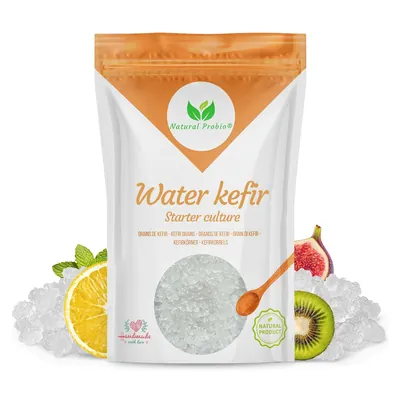
 Water kefir
 Milk kefir
 Kombucha
 Ginger beer
 Kefir duo
 Kefir and kombucha
 Starter kit
 Rennet
Strawberries are the easiest fruit to start with when you first add flavour to water kefir. They give up their colour within hours, their sugar feeds the second fermentation, and you end up with a pale pink drink that is sharp, lightly sweet and properly fizzy. Children who turn up their noses at plain kefir tend to ask for a second glass of this one. Adults drink it from a wine glass with plenty of ice.
Ingredients
- 1 litre freshly strained water kefir
- 150 g ripe strawberries, fresh or frozen
- 1 teaspoon sugar (optional)
Method
- Make a standard batch of water kefir: 30 g grains, 4 tablespoons sugar (about 60 g), 1 litre water, 1 dried fig and 1 slice of lemon, left for 24 hours at 20 to 25°C. Strain out the grains and put them straight back into fresh sugar water.
- Wash and hull the strawberries, cut them into quarters and crush them lightly with a fork so the juice starts to run.
- Put the strawberries and the sugar into a clean 1 litre swing-top bottle.
- Pour in the water kefir through a funnel, stopping about 3 cm below the rim, and close the bottle.
- Leave the bottle at room temperature, out of direct sun, for 24 to 48 hours.
- Chill it for a few hours. Open it cold and slowly over the sink, then pour through a small sieve into glasses.
Which strawberries work best
Ripeness matters far more than size. In June and July, when British strawberries are at their best, the small, dark red berries sold by the punnet have much more flavour than the big pale ones on the shelves in winter. A few soft strawberries that are past their best for the table are perfect here: they give plenty of juice and sugar, and nobody sees them once they have done their work.
Out of season, frozen strawberries do the job well. Let them thaw in a bowl and tip the juice into the bottle along with the fruit. Freezing has already broken the cells, so the colour comes out faster and turns deeper, and the flavour leans a little towards strawberry jam. On a wet February evening that is no bad thing.
It all starts with the first fermentation
How the finished drink tastes depends largely on the batch you start with. Taste before you strain: the kefir should still be slightly sweet and already clearly tart. If it is still very sweet, give it a few more hours on the worktop. With 60 g of grains you can make 2 litres at a time and flavour two bottles, one with strawberries and one with something else.
The full basic method is in How to make water kefir, and everything about the closed bottle stage is in the guide to the second fermentation. If your tap water smells of the swimming pool, read water and sugar for water kefir before your next batch.
Variations
- Strawberry and mint: add four fresh mint leaves to the bottle. Cool and very summery.
- Strawberry and basil: two basil leaves in the bottle and a twist of black pepper in the glass. It sounds odd and tastes surprisingly grown-up.
- Strawberry and rhubarb: 100 g strawberries with 2 tablespoons of the syrup from the rhubarb water kefir. Both are around in May and June.
- Strawberry and elderflower: one or two flower heads in the bottle, as in the elderflower water kefir. Fragrant and fruity at once.
- Strawberry and lemon: the juice of half a lemon makes it drier and sharper.
Serving and storing
Pour it cold, through a tea strainer, over a few ice cubes, with a slice of strawberry on the rim. For a summer jug, dress it like a classic summer fruit cup: sliced strawberries, a few ribbons of cucumber and a handful of fresh mint. It makes a good alcohol-free drink for a birthday, a christening or a long evening in the garden, if the weather holds. If you would rather freeze it, the water kefir ice lollies use the same flavours.
Keep an opened bottle in the fridge and drink it within a few days. The cold slows the fermentation down without stopping it, so the drink gets slowly drier and sharper. The strained strawberries are soft and tangy: stir them through yoghurt or spoon them over strained kefir cheese.
Frequently asked questions
Why is my strawberry water kefir not fizzy?
Can I put the strawberries in the jar with the grains?
How long can I leave the bottle out?
Is there alcohol in it?
No grains in the house yet? With our live water kefir grains you can start a new batch every day. All the recipes and guides are on the water kefir page.