
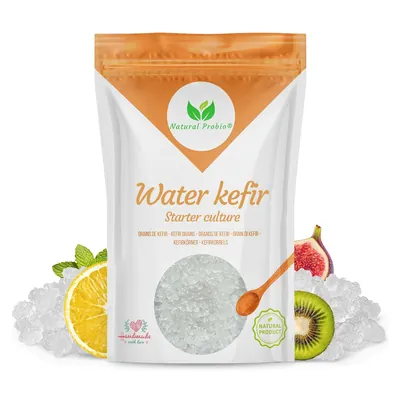
 Water kefir
 Milk kefir
 Kombucha
 Ginger beer
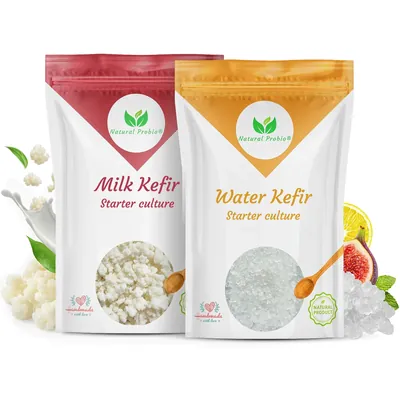 Kefir duo
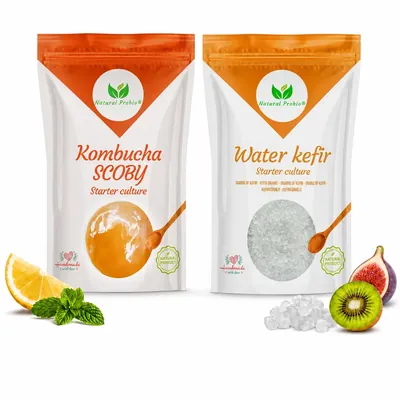 Kefir and kombucha
 Starter kit
 Rennet
British tap water works well once the chlorine has gone: let it stand uncovered for a few hours, or boil it and let it cool. Still mineral water and a private supply that is fit to drink are fine too. For sugar, use granulated cane sugar, ordinary granulated sugar or golden caster sugar: 4 tablespoons (about 60 g) per litre. Avoid distilled water, water from a softener and every kind of sweetener. Honey and syrups are for the bottle, not the daily batch.
Why water and sugar matter so much
The grains live on sugar. The yeasts and lactic acid bacteria inside them turn it into gentle acids, aroma and carbon dioxide. Without real sugar, nothing happens at all. The water is the other half: it carries the calcium and magnesium the grains need to stay firm and to grow. With very little of those, over time, they become small and soft. With too much chlorine, they struggle to get going.
You do not need to buy anything special. Start with what you have, and only look harder at these two ingredients if things are not working. The basic recipe is in How to make water kefir.
UK tap water: deal with the chlorine first
Mains water across the UK is treated with chlorine so that it arrives safe to drink. That is exactly what it should do, but the grains are not fond of it. Fortunately, chlorine is easy to get rid of:
- Let it stand. Fill a jug or the jar itself and leave it uncovered for a few hours, or overnight. Most of the chlorine simply escapes into the air.
- Boil and cool. Boil the kettle, pour the water into the jar and let it come right back down to room temperature. Handy, because you can dissolve the sugar in it while it is still warm.
Some days the water smells more strongly of chlorine than others. On those days, give it a bit longer on the worktop. If you notice that your first batches are slow and the water smells like the local swimming baths, this is the first thing to fix.
Hard water, soft water: it depends where you live
The other thing that varies is hardness, meaning how much calcium and magnesium the water carries. Britain has both extremes, and the map follows the rocks underneath: chalk and limestone give hard water, granite and upland moors give soft water.
| Area | Typical water | What it means for water kefir |
|---|---|---|
| London, the South East and East Anglia | Hard, chalky, leaves limescale in the kettle | Usually very good: the grains have plenty to work with and grow steadily |
| Scotland, Wales and the North West (the Lake District, Manchester) | Soft, sometimes slightly peaty | Works, but the grains can stay small and soft over time |
| Most of the rest of the country | Moderately hard | No special measures needed |
Not sure what comes out of your tap? Your local water company publishes the hardness for every postcode on its website: type in your postcode and you have the answer in a minute. A limescale-crusted kettle is a fairly reliable clue as well, and a sign that your grains will be happy.
If you live in a soft water area and your grains are fermenting nicely, there is nothing to change. If they are shrinking or not growing after a few weeks, try a still mineral water for a while, or swap a spoonful of the white sugar for cane sugar. Hardness only affects how the grains behave and how the drink tastes, nothing more.
Private water supplies
Some homes in rural areas, from the Highlands to the Welsh hills and the farms of Devon and Cumbria, are on a private water supply rather than the mains: a borehole, a well or a spring. That water usually has no added chlorine, so you can use it straight from the tap, provided it is fit for drinking. Its hardness depends on the ground it comes through: limestone and chalk give hard water, granite and peat softer water.
- If the household drinks the water as it is, you can use it for water kefir as it is.
- If the supply goes through a softener, draw your kefir water from a tap that bypasses it, or use a still mineral water.
- If the water has a strong colour or a metallic taste, a still mineral water gives a cleaner flavour in the glass.
Which water works, and which does not
| Water | Suitable? | Note |
|---|---|---|
| Tap water, left to stand | Yes | The easiest choice in most of the country |
| Tap water, boiled and cooled | Yes | Quickest way to remove the chlorine |
| Still mineral water | Yes | Good with very soft tap water, or when the grains are not growing |
| Private supply fit for drinking | Yes | Usually no chlorine to deal with |
| Water from a filter jug | In moderation | Takes out part of the calcium; give them ordinary water now and then |
| Sparkling mineral water | Better not | The fizz disappears anyway, and some are quite salty |
| Water from a softener | No | Calcium taken out, often sodium put in |
| Distilled or reverse osmosis water | No | Nothing left in it at all, the grains weaken |
Which sugar?
Any ordinary sugar from the baking aisle will do. The difference lies in the taste and colour, and a little in how the grains respond.
| Sugar | Taste of the kefir | For every day? |
|---|---|---|
| Granulated cane sugar | Clean, lightly rounded | Yes, an excellent standard |
| Ordinary white granulated sugar | Light, neutral, lets the fruit come through | Yes |
| Golden caster sugar | Rounder, a hint of caramel, golden colour, dissolves fast | Yes |
| A mix of white and golden | Fresh with a little depth | Yes, a good standard |
| Light muscovado or demerara | Soft, toffee-like | In moderation: a spoonful in the mix |
| Dark muscovado, coconut sugar | Heavy, almost treacly | Rarely, and only as part of the mix |
| Honey | Fragrant, pronounced | No, only in the bottle |
| Golden syrup, maple or agave syrup | Pronounced | No, only in the bottle |
| Sweeteners, stevia, xylitol, erythritol | Nothing: no fermentation happens | No |
Many people settle on a fixed mix: three tablespoons of granulated sugar and one of golden caster. That gives a fresh kefir with a bit more character. Light muscovado is lovely for a toffee note, but keep it to a spoonful: on its own it makes the drink heavy and can slow the grains down over time. Sweeteners, whatever the packet says, give the grains nothing to eat.
How much sugar?
Four tablespoons, about 60 g, per litre of water. That sounds like a lot, but most of it is food for the grains. After 24 hours a good part of the sugar has been used up and the drink is only lightly sweet. Leave it longer and it becomes drier and sharper.
- Less sugar than 4 tablespoons is possible, but the grains get less to eat. Over time they grow less and the drink turns flat.
- More sugar does not make the drink better. It just becomes sweeter and sometimes more yeasty.
- Want it less sweet? Leave the batch a little longer instead of cutting back on the sugar.
What a litre costs you in sugar, water and fruit is worked out in The cost of making kefir at home. It is less than you might think.
The fig and the lemon
Strictly speaking you could do without them, but they make your water kefir much better.
The dried fig brings flavour and gives you a handy signal: on the bottom, the batch is still working; floating, it is ready. Choose a soft fig without sulphites. No fig in the cupboard? A date, a few raisins or a dried apricot work too, although they do not float as clearly.
The slice of lemon adds a fresh sharpness and helps keep the drink in balance. Wash the lemon well, or buy unwaxed, because the peel goes into the jar. A slice of lime works too. Orange is nice but quickly brings a bitter note.
When the grains do not grow or turn soft
The cause is nearly always the water, with soft or filtered water at the top of the list. Work through it one step at a time:
1. Change the water
Switch to a still mineral water for a week, or to ordinary tap water left to stand if you have been using a filter jug.
2. Add a little golden sugar
Replace one tablespoon of white sugar with golden caster or a spoonful of light muscovado.
3. Never forget the fig
A fresh dried fig in every batch, never reused.
4. Check the temperature
Between 20 and 25°C they grow best. Too warm and they wear themselves out.
No improvement after a few weeks? See Water kefir problems and how to fix them. Keeping the grains in good shape, holidays included, is covered in Caring for water kefir grains.
Frequently asked questions
Do I have to boil the tap water?
How do I find out how hard my water is?
Can I make water kefir without sugar?
Can I use honey?
Is very hard water a problem?
My grains have turned brown from golden sugar. Does it matter?
No grains yet? Our live water kefir grains start at £11, in 30 g or 60 g, delivered across the UK, VAT included. You can pay by Visa or Mastercard, Apple Pay, Google Pay, PayPal or Klarna. Every step is explained in the complete water kefir guide.