
 Water kefir
 Milk kefir
 Kombucha
 Ginger beer
 Kefir duo
 Kefir and kombucha
 Starter kit
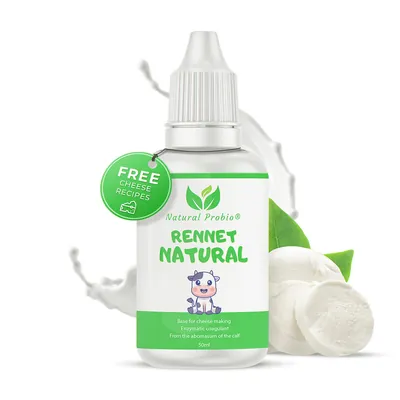 Rennet
Fresh goat's cheese is the best cheese to start with if you have never made cheese before. No press is involved, it needs no ageing, and you are done in an afternoon. Goat's milk gives a snow white, soft cheese with a fresh acidity and that typical, mild goat flavour. The rennet sets the milk; a splash of milk kefir adds a little acidity and flavour. That is all there is to it. Britain has a long tradition of farmhouse cheese, and this is a fine way into it at your own kitchen table.
Ingredients
- 3 litres fresh or pasteurised goat's milk (not UHT)
- 3 tablespoons milk kefir
- 0.5 ml liquid calf rennet (about 10 drops)
- 3 tablespoons cooled boiled water
- 1 and a half teaspoons fine salt
Method
- Warm the goat's milk in a large pan over a low heat to 32 to 35°C, stirring regularly and checking with a kitchen thermometer.
- Take the pan off the heat, stir in the milk kefir and leave the milk covered for 30 minutes.
- Dilute the rennet in the cold water. Pour it into the milk and stir gently from top to bottom for one minute.
- Leave the milk covered and undisturbed for 30 to 45 minutes, until the curd is firm and a clean cut fills with clear, yellowish whey.
- Cut the curd into cubes of about 2 cm and leave them to rest for 10 minutes.
- Ladle the curd gently with a slotted spoon into a colander lined with cheesecloth, or into cheese moulds. Sprinkle the salt between the layers.
- Let the cheese drain for 1 hour at room temperature, turn it over and let it drain and firm up for another 3 hours in the fridge.
The milk: fresh or pasteurised, never UHT
Goat's milk is on the shelf in most supermarkets, and sometimes you can buy it straight from a goat farm. Pasteurised milk works perfectly. UHT milk does not work for cheese: the intense heating changes the proteins so much that the milk will not form a proper curd with rennet. Check the label carefully, as long-life goat's milk is quite common.
Rennet: a coagulant, not a culture
Liquid calf rennet is a coagulant. It contains the enzyme that makes milk proteins clump together into a firm curd. It does not ferment and is not a live culture. The milk kefir in this recipe brings the acidity and flavour. For 10 litres of milk you need 1 to 2 ml of rennet, at 32 to 35°C, and the milk sets in 30 to 45 minutes. For 3 litres that comes to about 0.5 ml, roughly 10 drops. A 50 ml bottle is enough for 250 to 500 litres of milk, so it lasts a long time. All the proportions are in how much rennet per litre.
Checking the curd
After 30 minutes, push a clean knife into the curd at an angle and lift it gently. If the curd splits cleanly and the cut fills with clear, yellowish whey, it is ready. If it is still soft and milky, wait another 10 to 15 minutes. More about this stage, which is the same for every fresh cheese, is in how to make fresh cheese.
Variations
- Herbs: roll the finished cheese in finely chopped chives, parsley and thyme.
- Black pepper: roll it in coarsely crushed black pepper.
- Honey and walnuts: drizzle with honey and scatter with walnuts. A lovely dessert.
- Ash: dust with a little edible vegetable ash for a traditional grey rind and a striking look.
- In oil: shape into small balls and keep in a jar of oil with herbs, garlic and chilli.
Serving and storing
Fresh goat's cheese is at its best within a few days. Wrapped in baking paper in a closed container in the fridge, it keeps for about five days. Serve it on oatcakes or wholemeal toast with a little honey, in a salad with roasted beetroot and the kombucha vinaigrette, or crumbled over a warm tart. The whey makes good ricotta from whey, so do not pour it away.
Frequently asked questions
Can I use cow's milk?
Why did my milk not set?
Do I need the milk kefir?
All you need to start is our liquid calf rennet and, for flavour, a little homemade kefir from milk kefir grains. All guides are on the cheese making page.