
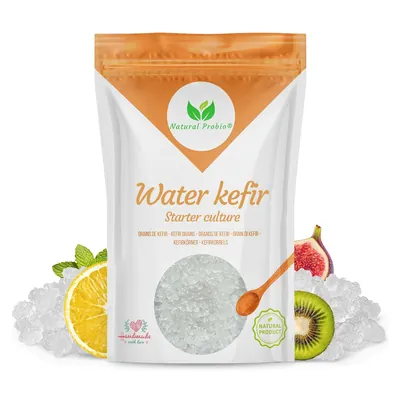
 Water kefir
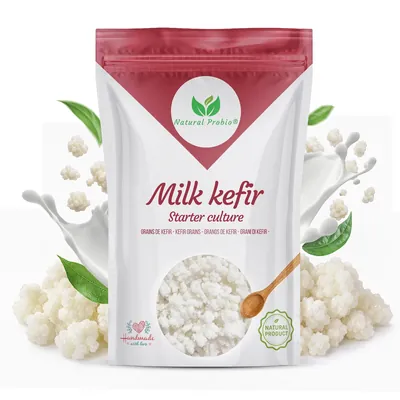 Milk kefir
 Kombucha
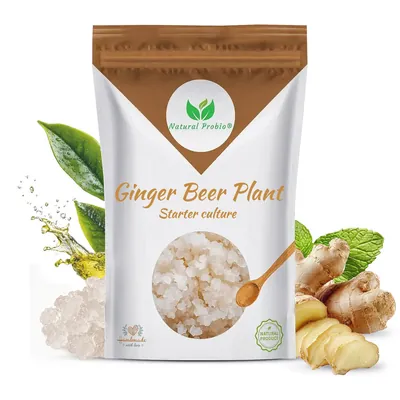 Ginger beer
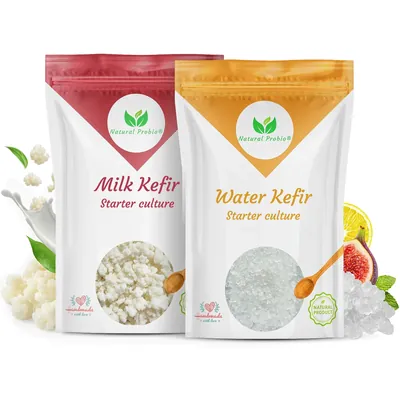 Kefir duo
 Kefir and kombucha
 Starter kit
 Rennet
Milk kefir comes from the Caucasus mountains, between the Black Sea and the Caspian. The grains were handed down through the generations there, and milk was fermented in leather bags or wooden vessels. Kefir then spread to Russia and, over the twentieth century, much further west. Water kefir has a separate and much hazier history, with names such as tibicos and Japanese water crystals. What the two have in common: a grain only ever comes from another grain.
Where does the word "kefir" come from?
Nobody knows for certain. The most common explanation links it to a Turkic word for a pleasant feeling, a sort of contentment.
Other theories do the rounds and none is fully proven. What is certain is that the word travelled with the drink and stayed almost the same in every language. In English we say kefir, and the little white clusters are kefir grains. You will sometimes hear them called a "kefir mushroom" too, although they are neither a mushroom nor a plant, but a living culture of yeasts and lactic acid bacteria. What those little cauliflower florets really are is explained in What are milk kefir grains?
Kefir in the Caucasus mountains
The old accounts tell of herders pouring the milk of their cows, goats or sheep into a leather bag along with the grains. The bag hung by the door of the house. Anyone coming in or going out gave it a nudge, so the milk kept moving. Out of it came a sour, slightly fizzy drink, and fresh milk was added as the kefir was drawn off. The culture carried on like that, season after season.
The grains were precious. They stayed in the family, were sometimes given as part of a dowry, and were not handed to strangers lightly. Some legends give them a divine origin and claim they would lose their strength if given away. Practice proved the opposite: the grains grow, divide and have always been shared.
From the Caucasus to the rest of the world
Kefir reached Russia first. According to a story told many times, half history and half legend, a Moscow dairy sent a young woman to the Caucasus to obtain grains from a local prince, who refused to part with them. The story ends well for kefir: the grains did eventually reach Moscow, and the drink slowly became a fixture on Russian tables, then in the countries all around.
Over the twentieth century, kefir settled into everyday life from Poland to the Baltic as a fermented milk, sold in bottles. Dairies found out then what anyone making it at home knows today: you cannot build a kefir grain from scratch. Powdered starter cultures exist and give a kefir with a slightly different character, but a grain only ever comes from another grain.
And in our own kitchens?
Here, other soured milks filled that role for a long time. In British farmhouses, the butter was churned by hand and the buttermilk left behind was never wasted: it went into the scones, the griddle cakes and the pancakes, or was drunk cold with a meal. Kefir and buttermilk have a lot in common, and kefir can take buttermilk's place in nearly every recipe, as Kefir or buttermilk? explains.
Milk kefir arrived much later, first among a handful of enthusiasts passing grains between them, then in bottles in the chilled aisle of the supermarket. In recent years making kefir at home has really taken off, a bit like sourdough. People who try it soon notice that homemade kefir is creamier, livelier in the mouth and easy to adjust to taste. It also sits very comfortably next to the yoghurt at breakfast, as Kefir or yoghurt? shows.
Water kefir: a separate story
Water kefir does not share the origins of milk kefir, and its history is far less well documented.
Its clear grains have been reported in several parts of the world, under all sorts of names. In Mexico there is tibicos, a sugar-water drink fermented with fruit. An old story says the grains formed on the pads of a cactus, though that has never been shown. Elsewhere they were known as Japanese water crystals, even though they probably have little to do with Japan. Today they are mostly called water kefir grains, sugary kefir grains or water kefir crystals. All those names are untangled in What are water kefir grains?
A distant cousin deserves a mention: the ginger beer plant. In British kitchens of the past, a jar of it kept the family ginger beer fizzing. It looks a little like water kefir, with a sharper, spicier character of its own. Its story is in What is a ginger beer plant?
What has changed, and what has not
The container, mostly. The principle has stayed the same: grains, milk, a day's wait.
| Then | Now | |
|---|---|---|
| Container | Leather bag, wooden vessel | Glass jar covered with a tea towel |
| Milk | Raw cow's, goat's or sheep's milk | Usually whole milk |
| Quantity | By eye | 20 g of grains to 1 litre of milk |
| Time | At the pace of the household | 24 hours at 20 to 25°C |
| How it is passed on | Within the family, as a dowry | By post, with instructions |
The modern method, with every step explained, is in How to make milk kefir.
A tradition of sharing
If one thing has lasted through the centuries, it is sharing. The grains grow with every batch, and sooner or later you will have too many. Giving a small jar of your surplus to someone who wants to start is your own way of keeping up the custom of those Caucasus families. Our cultures come from traditional methods: unique and vigorous, ready to start a new line in your kitchen.
Frequently asked questions
Where does kefir come from?
Do milk kefir and water kefir have the same origin?
Can I make kefir grains myself?
Did kefir always take 24 hours?
Fancy writing the next chapter in your own kitchen? Our live milk kefir grains start at £14, and the complete milk kefir guide is with you from the first batch. If you would rather have a dairy-free drink, try water kefir grains instead.