
 Water kefir
 Milk kefir
 Kombucha
 Ginger beer
 Kefir duo
 Kefir and kombucha
 Starter kit
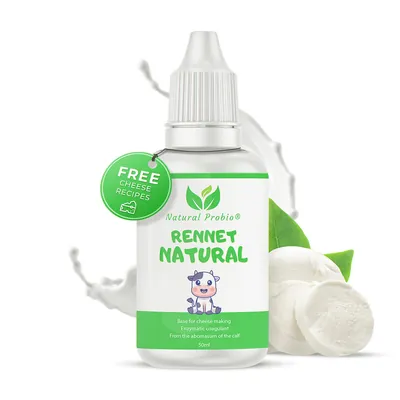 Rennet
Heat the fresh whey from your cheese to 85 to 90°C without letting it boil. Turn off the heat, add a tablespoon of vinegar or lemon juice per litre of whey, stir once and wait about ten minutes. Small white flakes gather on the surface. Lift them with a slotted spoon into a sieve lined with fine cloth and let them drain. That is your ricotta. The yield is small; a glass of whole milk per litre of whey makes it a good deal bigger.
What ricotta actually is
When you make cheese, the rennet holds most of the milk protein in the curd. But not all of it. Part of the protein, the whey protein, does not respond to rennet and stays behind in the liquid. With heat and a little acid, those proteins clump together after all and float to the top as soft white flakes. That is ricotta.
So true ricotta needs no rennet of its own. It comes from what the cheese leaves behind. The name is Italian and means something like "cooked again". The idea is known wherever cheese is made: nothing from the milk goes to waste.
What you need
- The whey from your cheese, as fresh as possible, ideally the same day.
- A tablespoon of vinegar or lemon juice per litre of whey. White wine vinegar or cider vinegar both work well. If you brew kombucha and have a bottle that has turned properly sour, that works too: see Kombucha vinegar.
- Optionally, a glass of whole milk per litre of whey, for a bigger yield.
- A pinch of salt.
- A pot, a thermometer, a slotted spoon and a sieve lined with fine muslin or cheese cloth.
The whey can come from any cheese you have made with liquid calf rennet: fresh, soft or hard. The best results come from the whey of a fresh cheese, which has been heated less and holds more protein. Whey from a hard cheese is a little thinner, but it still works, especially with some milk added.
Step by step
1. Heat the whey
Pour the whey into a pot and heat it over a medium flame to 85 to 90°C. Stir along the bottom now and then so nothing catches. It must not boil.
2. Add milk, if using
For more ricotta, pour in the milk once the whey reaches about 60°C, then keep heating.
3. Add the acid
Once you reach the temperature, turn off the heat, pour in the vinegar or lemon juice and stir once, very gently.
4. Wait
Leave the pot for about ten minutes. The white flakes rise and gather on the surface.
5. Skim and drain
Lift the flakes gently with the slotted spoon into the cloth-lined sieve. Let them drain for half an hour to two hours, depending on how firm you want it.
How much ricotta you get
To be honest: not a lot. The whey from 5 litres of milk gives a small bowlful. Ricotta is most worth it when you make bigger cheeses, such as a 10 litre hard cheese, or when you add milk to the whey.
A glass of whole milk per litre of whey makes the yield clearly bigger, and the ricotta creamier and a little richer in flavour. Most people who try it once never go back.
The texture you want
| Draining time | Texture | Good for |
|---|---|---|
| About 30 minutes | Very creamy, spreadable | On toast, as a dip, beaten smooth with a spoon of cream |
| About 1 hour | Light and moist | Cheesecake, fillings, pancakes |
| About 2 hours | Firm, sliceable | Salads, pasta, for baking |
Add salt only at the end, over the drained ricotta. That way you control the amount, and for sweet dishes you can simply leave it out.
What to do with it
Still warm, with a thread of honey and a few walnuts, fresh ricotta is a small reward after an afternoon of cheese making. But it can do much more:
- On toasted sourdough with tomato, olive oil and basil.
- In the batter for pancakes on Pancake Day: they come out extra light.
- In a baked cheesecake with a biscuit base, for Sunday.
- With spinach as a filling for cannelloni or a lasagne.
- With jam, fresh berries or stewed Bramley apple as a quick dessert.
- With garden herbs, garlic and pepper, as a dip for the barbecue.
Two quick ideas
Ricotta with apple and cinnamon. Fry a diced apple briefly in a knob of butter with a teaspoon of sugar and a pinch of cinnamon. Spoon some warm ricotta into a bowl and top with the warm apple. Scatter a few toasted oats over the top and it tastes like a lazy apple crumble.
Herby ricotta on wholemeal toast. Stir salt, pepper, chopped chives and a little grated lemon zest into well-drained ricotta. Spread it thickly on warm wholemeal toast and top with sliced radish or cucumber. For lunch, or with drinks.
When it does not work
| What you see | Cause | What helps |
|---|---|---|
| No flakes, or hardly any | Too cool, or not enough acid | Bring it to 85 to 90°C, add another tablespoon of vinegar |
| Flakes slip through the cloth | Stirred too much after adding the acid | Stir only once, gently, and use a finer cloth |
| Ricotta tastes of vinegar | Too much acid | Less next time; you can rinse it briefly in cold water |
| Dry and crumbly | Too hot, or drained too long | Do not let it boil, take it out of the cloth sooner |
| Burnt on the bottom | Heat too high | Medium heat, stir along the bottom now and then |
Most of these come down to the thermometer. Keep an eye on the temperature and you will nearly always get lovely big flakes.
Keeping it
Ricotta is fragile. Keep it in a closed container in the fridge and eat it within two or three days. If it smells sour or changes colour, do not eat it.
And the whey after that?
Even after the ricotta there is whey left, now clearer and thinner. You still do not need to pour it away. Use it to cook pasta, rice or potatoes, or instead of milk or buttermilk in a batch of scones. A cheese day where nothing goes down the sink: that is how it was always done on the farm.
Frequently asked questions
Do I need rennet for ricotta?
Can I keep whey overnight and make ricotta tomorrow?
Can I make ricotta from plain milk?
Can I freeze ricotta?
No cheese yet, so no whey? Start with a fresh cheese and our liquid calf rennet, a 50 ml bottle for £13 that sets 250 to 500 litres of milk. Everything about milk, equipment and styles of cheese is on the cheese making page.