
 Water kefir
 Milk kefir
 Kombucha
 Ginger beer
 Kefir duo
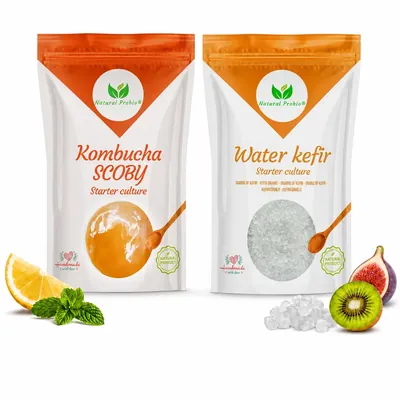 Kefir and kombucha
 Starter kit
 Rennet
Lift out the SCOBY and keep back a cup of starter liquid. Pour the rest of the kombucha into swing-top bottles with a little fruit, juice, ginger or herbs, leaving two or three fingers of air under the cap. Close them and leave them at room temperature for 2 to 5 days, then move them to the fridge, where the fermentation almost stops and the fizz stays in.
What happens in the bottle
During the first fermentation the jar sits open under a cloth. The yeasts make gas, but it drifts away through the top. That is why fresh kombucha only fizzes gently on the tongue.
In a closed bottle the gas has nowhere to go. The yeasts find fresh sugar in the fruit or juice, get back to work, and the carbon dioxide dissolves into the drink. When you open the bottle it hisses, and fine bubbles rise in the glass. At the same time the fruit flavours the kombucha, so a sharp tea drink turns into something closer to a dry, grown-up lemonade.
What you need
- Finished kombucha from the first fermentation, ideally with a hint of sweetness left. How to brew it is in How to make kombucha.
- Swing-top bottles of thick glass with a rubber seal that is still soft. Thin juice bottles and screw-cap bottles are not made for pressure.
- A funnel and a fine sieve, plastic or stainless steel.
- Something for flavour: fruit, juice, fresh ginger, herbs or spices.
Step by step
1. Look after the culture
With clean hands, lift the SCOBY out of the jar and set aside a cup of kombucha (about 250 ml) for the next batch. Start that batch first, so the SCOBY is back in sweet tea quickly.
2. Flavour in the bottle
Put the fruit, juice or spices into the empty bottles. Small pieces give up their flavour faster than big chunks.
3. Fill
Pour the kombucha in through the funnel and sieve. Leave two or three fingers of air under the cap: that space is where the pressure builds.
4. Close and wait
Shut the swing-tops and leave the bottles at room temperature for 2 to 5 days, out of the sun. A cupboard or a cardboard box on the floor is a good spot.
5. Chill
When the fizz is right, the bottles go into the fridge. Cold kombucha holds its gas better and foams far less when you open it.
What goes well in kombucha?
Almost anything you would put in a glass of lemonade works in kombucha. A few combinations that never let you down:
| What goes in | Flavour | How much, per 1 litre |
|---|---|---|
| Fresh ginger with lemon | Sharp, warming, clean | A few thin slices of ginger and a strip of lemon zest |
| Raspberries, strawberries, blackberries | Fruity, pink or deep red in the glass | A small handful, lightly crushed |
| Apple juice with cinnamon | Rounded, autumnal | A splash of cloudy apple juice and half a cinnamon stick |
| Elderflower cordial | Fragrant, summery | A small splash: cordial is sweet and works fast |
| Rhubarb | Fresh, tart | A couple of spoons of stewed rhubarb or its juice |
| Mint or basil | Cool, herby | A few leaves, lovely with red fruit |
Worked-out recipes with exact quantities are the ginger and lemon kombucha, the berry kombucha and the apple and cinnamon kombucha, which comes into its own once the evenings draw in.
Through the year in a bottle
The second fermentation is most fun when you follow the seasons, so your kombucha tastes a little different every month.
- Spring: forced rhubarb, stewed with a pinch of vanilla.
- June: a couple of elderflower heads from the hedge, given a good shake to send the insects on their way, or a splash of homemade cordial.
- Summer: strawberries, raspberries, redcurrants. Crushed raspberries with a mint leaf is the drink for a sunny afternoon in the garden, whenever one turns up.
- September: hedgerow blackberries, picked high enough to be clean.
- Winter: orange peel, a clove, a piece of star anise. Around Christmas it makes a lively drink to put on the table for anyone who is driving or skipping the wine.
The only rule is that the fruit is clean and ripe. Mouldy or mushy pieces do not belong in a bottle.
Which bottles work best?
The classic swing-top is the right choice here. Plenty of people have a few kept from a bottle of lemonade or craft beer, and those are perfect as long as the glass is thick and the seal still soft. Spare rubber seals are cheap and easy to replace: change them as soon as they turn hard or show cracks.
| Bottle | Suitable? | Why |
|---|---|---|
| Thick glass swing-top, 500 or 750 ml | Yes | Seals well, holds pressure, easy to clean |
| Small swing-tops, 330 ml | Yes | One glass each, so you only open what you drink |
| Preserving jar with a clip lid | Not ideal | Often not tight enough for real fizz |
| Thin juice bottle with a screw cap | No | Not made to take pressure |
| Plastic fizzy drink bottle | Only as a tester | Shows clearly how much pressure has built |
Rinse bottles with hot water and a bottle brush straight after use. Dried kombucha with bits of fruit is far harder to shift later.
How long in the bottle?
The range of 2 to 5 days depends mainly on temperature and sugar. In a warm spell at 25°C, the fizz can be lively after two days. In a cool British kitchen in winter, with the heating off overnight, four or five days is more usual.
Juice and very ripe fruit bring plenty of sugar and speed things up. Herbs and spices alone bring very little, so the fizz comes more slowly. If you want bubbles without fruit, add a teaspoon of sugar per bottle.
Open the first bottle over the sink after two days. If it only sighs, leave the rest a little longer. If it foams up straight away, they all go into the fridge.
Keeping the pressure in hand
Fizz is the goal, but too much of it turns opening a bottle into a messy business. A few habits keep it calm:
- Use only swing-tops made for pressure and check the seals now and then.
- In warm weather, let a little pressure out once a day: open the cap and close it again straight away.
- Chill the bottles before opening. Cold kombucha foams much less.
- Drape a tea towel over the cap, hold the bottle at an angle and release the clip slowly.
When it does not go to plan
| What you notice | Usual cause | What helps |
|---|---|---|
| Hardly any fizz | Too cold, or too little sugar left | A warmer spot, a splash of juice or some fruit |
| No fizz at all, even somewhere warm | The seal is not closing | A new rubber seal or another bottle |
| Foams over when opened | Too warm, too long or a lot of fruit sugar | Chill sooner, less juice, release pressure along the way |
| Very sour | The first fermentation ran long | Bottle earlier next time, use sweet fruit |
Small jelly-like discs or brown threads in the bottle are normal: the culture carries on working there too. Simply pour your glass through a small sieve. If you are unsure about something floating in the bottle, see Kombucha: mould or normal?, and if the whole batch has turned too dry and sharp, Kombucha too sour? will help.
No SCOBY yet? Our live kombucha SCOBY with starter liquid costs £16, and your first bottles can be fizzing about two weeks after it arrives. Everything else is on the kombucha page.