
 Water kefir
 Milk kefir
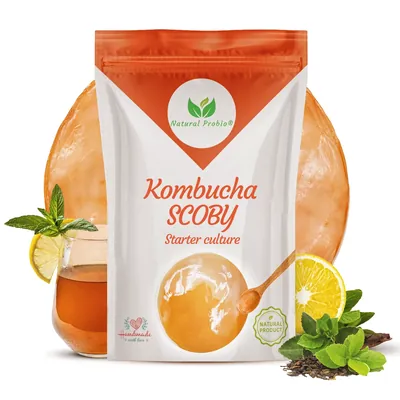 Kombucha
 Ginger beer
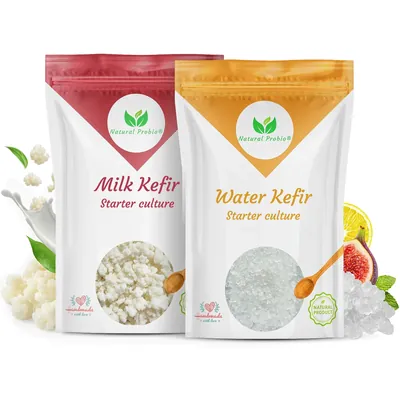 Kefir duo
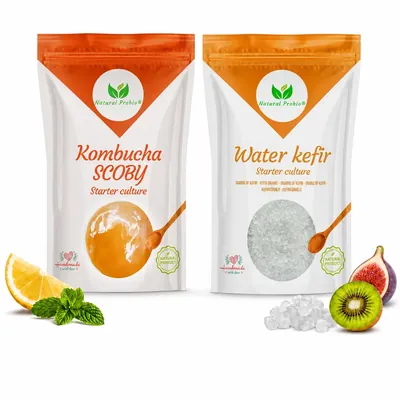 Kefir and kombucha
 Starter kit
 Rennet
Kombucha needs real tea from the tea plant: black, green, white or oolong, with nothing added to flavour it. Use 3 tea bags or about 8 g of loose tea per litre of water, with 80 g of sugar. Plain black breakfast tea is the easiest place to start and gives a full, amber kombucha. Herbal teas, fruit infusions, rooibos and flavoured teas such as Earl Grey should not be the only tea in the jar: add those flavours in the second fermentation, in the bottle.
The ground rule: real tea
Your SCOBY needs two things: sugar to feed on and tea from the tea plant, Camellia sinensis. Black, green, white and oolong all come from that one plant. The difference lies in how the leaves are handled after picking, not in the plant itself.
Camomile, peppermint, rooibos, berry infusions and most of the other "teas" at the back of the cupboard come from entirely different plants. They are lovely in a mug at night. As the only base for kombucha they do not work well: the fermentation is slow to start and the culture weakens over a few batches.
The teas side by side
| Tea | Your kombucha | Suitable? |
|---|---|---|
| Black breakfast tea (Assam, Kenyan, Ceylon blends) | Full, rounded, slightly malty, amber | Very good, ideal to start with |
| Darjeeling | Finer, more fragrant, a little lighter | Very good |
| Green tea (sencha, gunpowder) | Light, fresh, slightly grassy, golden | Very good, often a touch faster |
| Black and green mixed | Balanced, with body and freshness | Very good, a fine everyday choice |
| White tea, oolong | Soft and delicate, sometimes fruity | Good, best mixed with some black tea |
| Earl Grey (bergamot oil), chai, other flavoured teas | Unpredictable | Best avoided in the jar: the oils slow the SCOBY |
| Herbal teas, fruit infusions, rooibos | Little fermentation | Not as a base, but fine for flavour in the bottle |
Builder's tea: the one you already have
In most British kitchens there is a box of strong black tea by the kettle that gets through more bags in a week than anything else in the house. Builder's tea, breakfast tea, the everyday bags you use for a proper brew: that is exactly what a SCOBY likes. These blends are made from robust black teas, they brew dark and strong, and they give a kombucha with real body, somewhere between cider and a dry apple juice.
It is also the most forgiving tea. Its strong flavour lets you taste clearly how the fermentation is moving from day to day, so you learn quickly when your batch is ready. A plain supermarket box does the job just as well as an expensive caddy, as long as there is no flavouring in it. The only difference from your morning cuppa is that the milk stays in the fridge: kombucha tea is always brewed black. Check the ingredients: if the word "flavouring" or "aroma" appears, keep that box for your mug.
Decaffeinated black tea works too, in principle, but the fermentation is often a bit slower. Mixing it half and half with ordinary tea keeps things moving.
Green tea and blends
Green tea gives a paler, lighter kombucha with a fresh, slightly grassy edge. Many people prefer it in summer, and it often ferments a day or so faster than black tea. A plain sencha is all you need.
The mix that many brewers settle on for good is two bags of black tea and one of green per litre: the body of breakfast tea with a little lift from the green. White tea and oolong are worth a try for special occasions, ideally with some black tea alongside, because on their own they can be a little thin for the SCOBY.
How much tea, and for how long?
The amount never changes: 3 tea bags or about 8 g of loose tea per litre of water. More tea does not make better kombucha, only a harsher one, and it upsets the balance in the jar. Less tea gives a thin drink and, over time, a culture that is missing something.
Brew the tea in part of the water, about half a litre, as you would for drinking it strong. Black tea can take boiling water. Green and white tea prefer it slightly cooler, so let the kettle sit for a few minutes after it clicks off. Leave black tea to steep for 10 to 15 minutes for a strong brew; take green tea out a little sooner, before it turns bitter. Loose tea goes in a tea strainer or infuser so no leaves end up in the jar.
Then dissolve the sugar in the hot tea, top up with cold water to 1 litre and wait until it is at room temperature. The full recipe is in How to make kombucha.
And the sugar?
For the SCOBY, sugar is not a matter of taste but of food. It needs 80 g per litre. Most of it is used up during the fermentation, which is why finished kombucha tastes far less sweet than the tea on day one.
| Sugar | Result |
|---|---|
| White granulated sugar | Reliable, clear tea flavour, the safest choice |
| Cane sugar | A little darker, lightly caramel, works well |
| Light brown sugar | Fuller and rounder, the fermentation can be a bit slower |
| Honey | A different drink altogether, not for your regular batch |
| Sweeteners, stevia, erythritol | Not suitable: the culture cannot feed on them |
Earl Grey, mint and fruit teas, in the bottle
Earl Grey deserves a word of its own, because it sits in so many British cupboards. Its scent comes from oil of bergamot sprayed onto black tea, and that oil is exactly what a SCOBY dislikes. A batch brewed entirely with Earl Grey may still ferment, but slowly and unevenly, and a culture kept on it batch after batch tends to tire. Lady Grey and other scented blends are in the same boat. If you really want to try it, use one Earl Grey bag with two plain ones, keep a spare SCOBY in reserve, and go back to plain tea at the first sign of a sluggish batch. Most brewers simply keep it for the mug.
Fond of Earl Grey, a cup of peppermint or a fruit infusion? You do not have to give up those flavours. The trick is to brew the batch with plain tea and add the flavour in the second fermentation, when the SCOBY is safely back in its own jar.
- Earl Grey: a strip of orange or lemon peel in the bottle gives that bergamot-like note without any oil in the jar.
- Fresh mint: a few leaves per bottle give a cool finish, lovely with a slice of lime.
- Rooibos: brew a strong cup, let it cool and add a splash to the bottle.
- Hibiscus: a small splash of cold-brewed hibiscus colours the kombucha deep red and adds a fruity tartness.
- Apple and cinnamon: half a cinnamon stick and a splash of apple juice, as in the apple and cinnamon kombucha.
How to fill the bottles and control the fizz is in Kombucha: the second fermentation.
The water
Tap water in the UK is fine for kombucha. It is treated with chlorine, but because you boil part of it for the tea, there is usually nothing more to do. If your water smells strongly of chlorine, leave the cold part in an open jug for a few hours before topping up. In London, the South East and East Anglia the water is usually hard, and you will know it from the scale in the kettle and the film that sometimes sits on a cup of tea; in Scotland, Wales and the North West it tends to be soft. Your local water company can tell you exactly how hard yours is. Either way it is only a question of taste: hard water can make the tea brew a little cloudier, and the kombucha comes out just the same. On a private supply, boil the water and let it cool before use.
Caffeine in kombucha
Because kombucha is made from real tea, the finished drink still carries some of the tea's caffeine. How much depends on the tea and the brewing time. If you avoid tea in the evening, treat kombucha the same way. For later in the day, water kefir is a good alternative, as it needs no tea at all. The comparison is in Water kefir or kombucha?
Frequently asked questions
Can I use ordinary tea bags?
Tea bags or loose tea?
Can I make kombucha with Earl Grey?
Can I use peppermint tea for kombucha?
Can I reuse tea bags from my morning cup?
Can I change tea whenever I like?
Ready to find out which tea you like best? With our live kombucha SCOBY and its starter liquid, £16, you can set your first batch going this week. Everything about kombucha is on the kombucha page.